
For Immediate Release
Source Data: UK Civil Aviation Authority (CAA) — Table 01: Size of UK Airports, Reporting Period 202601
UK Aviation Report 2026
UK Aviation 2026: 300 Million Journeys, Winners, Losers and What Every Passenger Needs to Know
Official CAA data covering all 47 UK airports reveals the airports surging ahead, the hubs quietly falling behind, and the remote communities whose lifeline flights are disappearing — with what every reader should do about it.
Based on UK CAA Official Data
Reporting Period: 2026/01
Published: April 2026
47 Airports Analysed
299.8M
+2.16%
47
13
This analysis, based on the UK Civil Aviation Authority’s official airport size data covering all 47 reporting airports, is intended as a resource for everyone with a stake in how Britain moves: the traveller deciding which airport to book through, the business rethinking its travel policy, the local authority making the case for infrastructure investment, the airline weighing its next route, and the islander wondering whether the twice-weekly service to the mainland will still be running next winter.
The numbers tell a story that is simultaneously encouraging and alarming, depending entirely on where you happen to live.
A nation takes flight — but not evenly
The headline figure of 299.8 million passengers is striking in itself. For context, that is equivalent to every man, woman and child in the United Kingdom boarding a plane more than four times over. Total UK passenger numbers rose by 6.3 million year-on-year — roughly the population of Greater Manchester added to the departure queue. And yet, of the 47 airports in the CAA dataset, 13 recorded a fall in passenger numbers. The recovery is real, but it is far from universal.
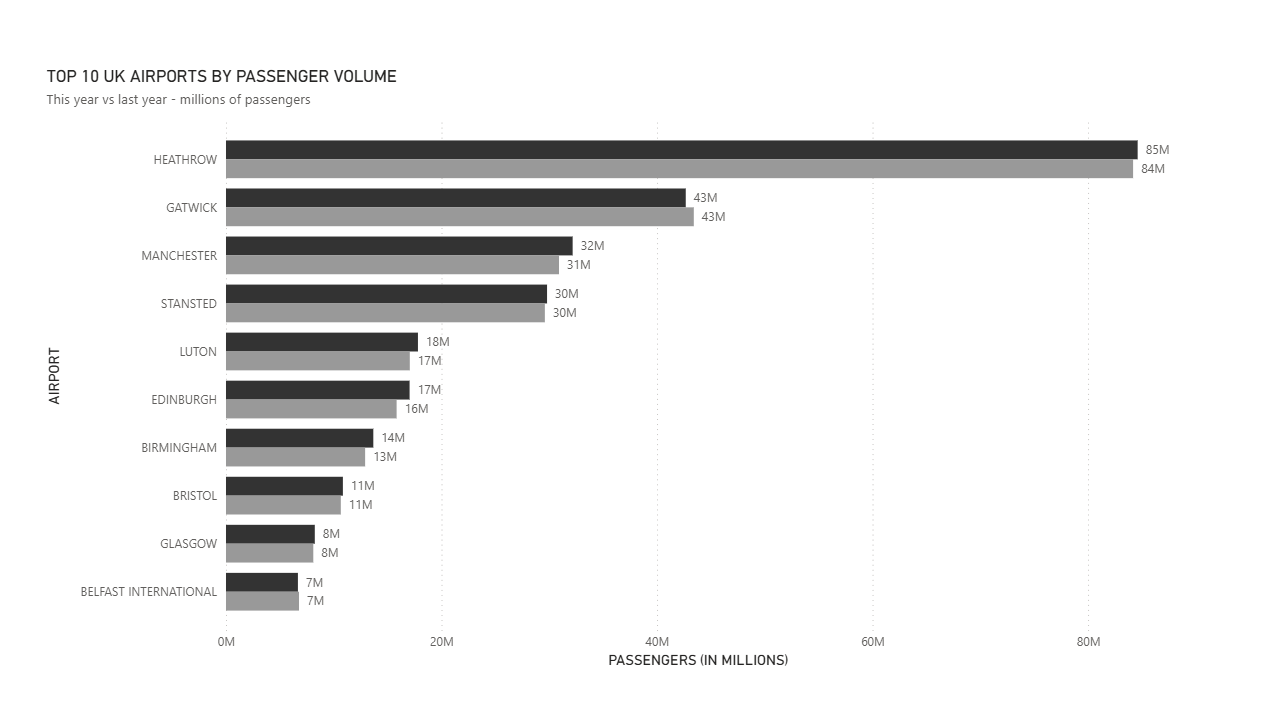
London’s six airports — Heathrow, Gatwick, Stansted, Luton, City and Southend — between them handled 179.4 million passengers, just under 60 per cent of the entire UK total. That concentration alone tells a story about the structural imbalance at the heart of British aviation, and raises a question that this data forces into sharp relief: what happens to the other 40 per cent?
| # | Airport | This Year (Pax) | Last Year (Pax) | Change | UK Share |
|---|---|---|---|---|---|
| 1 | Heathrow | 84,603,570 | 84,180,399 | +0.5% | 28.22% |
| 2 | Gatwick | 42,666,682 | 43,414,045 | -1.7% | 14.23% |
| 3 | Manchester | 32,170,141 | 30,904,961 | +4.1% | 10.73% |
| 4 | Stansted | 29,795,138 | 29,592,183 | +0.7% | 9.94% |
| 5 | Luton | 17,813,767 | 17,058,267 | +4.4% | 5.94% |
| 6 | Edinburgh | 17,037,853 | 15,834,329 | +7.6% | 5.68% |
| 7 | Birmingham | 13,671,652 | 12,912,064 | +5.9% | 4.56% |
| 8 | Bristol | 10,848,134 | 10,655,625 | +1.8% | 3.62% |
| 9 | Glasgow | 8,241,336 | 8,102,167 | +1.7% | 2.75% |
| 10 | Belfast Intl | 6,675,029 | 6,776,405 | -1.5% | 2.23% |
| 11 | Liverpool JL | 5,603,460 | 5,101,856 | +9.8% | 1.87% |
| 12 | Newcastle | 5,505,748 | 5,159,052 | +6.7% | 1.84% |
| 13 | Leeds Bradford | 4,444,631 | 4,236,150 | +4.9% | 1.48% |
| 14 | East Midlands | 3,957,390 | 4,094,259 | -3.3% | 1.32% |
| 15 | London City | 3,735,108 | 3,587,694 | +4.1% | 1.25% |
| 16 | Belfast City | 2,369,774 | 2,403,203 | -1.4% | 0.79% |
| 17 | Aberdeen | 2,291,626 | 2,302,634 | -0.5% | 0.76% |
| 18 | Bournemouth | 1,390,103 | 1,089,378 | +27.6% | 0.46% |
| 19 | Cardiff Wales | 966,196 | 877,261 | +10.1% | 0.32% |
| 20 | Southampton | 886,491 | 854,191 | +3.8% | 0.30% |
| 21 | Inverness | 823,040 | 801,335 | +2.7% | 0.27% |
| 22 | Southend | 751,449 | 287,423 | +161.4% | 0.25% |
| 23 | Prestwick | 617,976 | 535,864 | +15.3% | 0.21% |
| 24 | Exeter | 576,865 | 446,444 | +29.2% | 0.19% |
| 25 | Norwich | 446,324 | 419,583 | +6.4% | 0.15% |
| 26 | Newquay | 393,435 | 412,919 | -4.7% | 0.13% |
| 27 | Sumburgh | 280,172 | 291,784 | -4.0% | 0.09% |
| 28 | Teesside Intl | 259,585 | 227,060 | +14.3% | 0.09% |
| 29 | City of Derry | 221,367 | 185,584 | +19.3% | 0.07% |
| 30 | Humberside | 159,357 | 151,054 | +5.5% | 0.05% |
| 31 | Kirkwall | 146,097 | 136,910 | +6.7% | 0.05% |
| 32 | Stornoway | 104,943 | 101,026 | +3.9% | 0.04% |
| 33 | Isles of Scilly | 72,363 | 68,251 | +6.0% | 0.02% |
| 34 | Lands End | 51,135 | 49,545 | +3.2% | 0.02% |
| 35 | Farnborough | 37,944 | 38,228 | -0.7% | 0.01% |
| 36 | Islay | 32,127 | 30,643 | +4.8% | 0.01% |
| 37 | Dundee | 28,256 | 30,047 | -6.0% | 0.01% |
| 38 | Benbecula | 26,094 | 26,495 | -1.5% | 0.01% |
| 39 | Blackpool | 19,311 | 18,261 | +5.7% | 0.01% |
| 40 | Barra | 11,896 | 11,091 | +7.3% | 0.00% |
| 41 | Tiree | 10,616 | 9,924 | +7.0% | 0.00% |
| 42 | Biggin Hill | 8,550 | 8,482 | +0.8% | 0.00% |
| 43 | Campbeltown | 7,194 | 6,987 | +3.0% | 0.00% |
| 44 | Wick JOG | 6,227 | 9,846 | -36.8% | 0.00% |
| 45 | Lerwick | 2,722 | 2,839 | -4.1% | 0.00% |
| 46 | Oxford | 73 | 2 | +3550.0% | 0.00% |
| 47 | Lydd | 4 | 6 | -33.3% | 0.00% |
One airport, one quarter of all UK flights. Is that a strength or a vulnerability?
Heathrow’s 84.6 million passengers make it, comfortably, the most-used airport in the UK. It handled more travellers than Gatwick and Manchester combined. Its 28.2 per cent share of all UK passenger journeys means that when anything goes wrong at Heathrow — a strike, a systems failure, adverse weather — it does not merely inconvenience a fraction of UK travellers. It disrupts more than one in four of them.
And yet Heathrow’s growth was a modest 0.5 per cent — the airport added just 423,000 passengers year-on-year, a figure that Edinburgh alone surpassed in absolute terms. The giant is not in retreat, but it is not leading the charge either.
"Heathrow handles 28% of all UK passengers — but grew at just 0.5%. Meanwhile, Edinburgh grew fifteen times faster."
UK CAA Airport Data Analysis, 2026
Edinburgh, Manchester and the quiet revolution in regional aviation
If one airport deserves the title of the year’s standout performer among major hubs, it is Edinburgh. Scotland’s capital airport added 1.2 million passengers year-on-year — a 7.6 per cent rise that makes it the fastest-growing airport of any significant scale in the UK. Edinburgh now handles 17 million passengers annually, putting it firmly in the tier of genuine national airports rather than regional ones.
Manchester, too, continued its quiet consolidation as the undisputed capital of northern aviation. Its 32.2 million passengers — up 4.1 per cent — cement its position as the UK’s third busiest airport, and its growth rate more than doubled Heathrow’s. For travellers in the North, the message from the data is increasingly clear: you no longer need to travel to London to travel to the world.
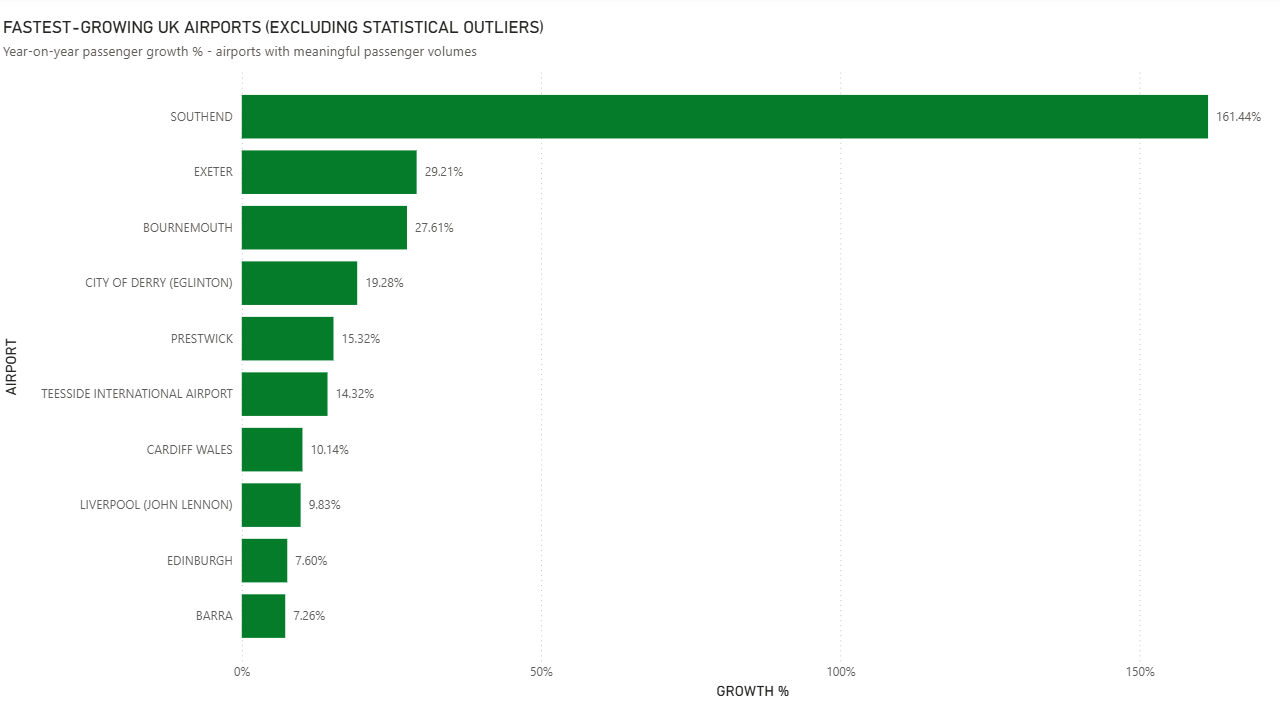
Further down the rankings, the growth story becomes even more striking. Bournemouth Airport grew by 27.6 per cent — from 1.09 million to 1.39 million passengers — suggesting that the south coast is finding its feet as a genuine travel hub. Exeter posted 29.2 per cent growth. Cardiff Wales was up 10.1 per cent. Liverpool John Lennon grew by 9.8 per cent. Leeds Bradford by 4.9 per cent. Teesside by 14.3 per cent.
Taken together, these numbers sketch a picture of a regional aviation ecosystem that is quietly, persistently outperforming London’s established mega-hubs — and offering passengers in those regions real alternatives for the first time in years.
FOR TRAVELLERS
If you live within reach of Edinburgh, Manchester, Liverpool, Bournemouth or Exeter, this data is your permission to stop defaulting to London. Faster-growing airports mean more routes, more competition and — typically — lower fares. Check your regional airport before you book.
FOR BUSINESS TRAVELLERS
If you live within reach of Edinburgh, Manchester, Liverpool, Bournemouth or Exeter, this data is your permission to stop defaulting to London. Faster-growing airports mean more routes, more competition and — typically — lower fares. Check your regional airport before you book.
Southend tripled its passengers. Here is what that actually means
No airport in the CAA dataset produced a more startling set of numbers than London Southend. Its passenger count rose from 287,423 to 751,449 — a 161 per cent increase in a single year. To put that bluntly: Southend carried two and a half times more passengers in 2025/26 than it did the year before.
This is not statistical noise. This dramatic rise was driven by enhanced carrier partnerships (particularly EasyJet), increased flight capacity, high punctuality, and efficient, speedy, customer-focused service. For passengers in Essex and east London, it is worth paying close attention to what Southend is offering. An airport that is growing this fast is an airport that is investing in its product.
Data Point Worth Noting
Southend Airport grew by 161% in a single year — from 287,423 to 751,449 passengers. That makes it, by percentage, the fastest meaningful growth story in UK aviation in 2026. For passengers in Essex, east London and the Thames Estuary, it deserves a place on your shortlist.
Gatwick’s unexpected reversal — and what it signals
Perhaps the most surprising entry in the loss column is not a remote Scottish airport or a coastal airstrip. It is Gatwick. The UK’s second busiest airport, the world’s most intensively used single-runway operation, lost passengers in a year when UK aviation as a whole grew by 2.16 per cent. Its 1.72 per cent decline — from 43.4 million to 42.7 million passengers — represents a loss of around 747,000 travellers year-on-year.
That is not a catastrophic number in the context of an airport handling 42 million people. But it is directionally significant. In a growing market, losing ground is a choice — or a consequence. Travellers appear to be redistributing themselves to Heathrow, Stansted and Luton, all of which held steady or grew.
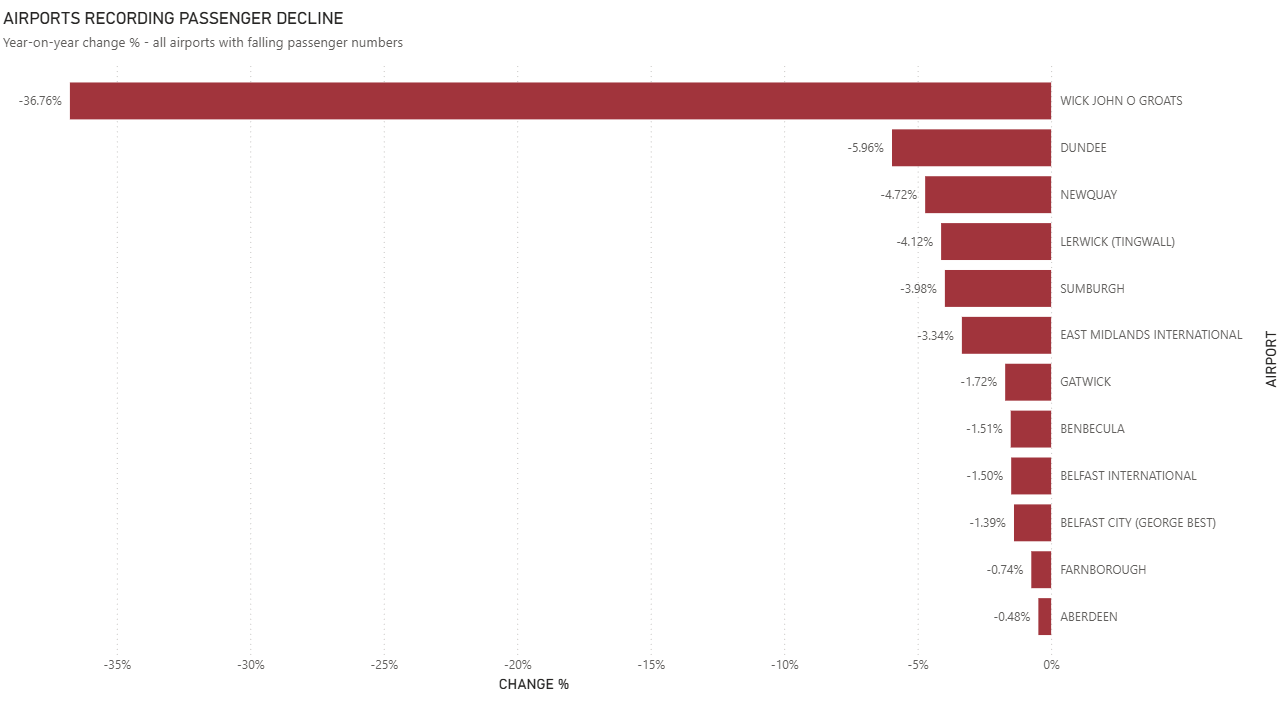
East Midlands International fell 3.3 per cent. Newquay dropped 4.7 per cent. Dundee declined by nearly 6 per cent. Belfast International was down 1.5 per cent, and Belfast City by 1.4 per cent — both Belfast airports moving in the wrong direction simultaneously, raising questions about the Northern Irish aviation market that go beyond individual airport strategy.
FOR CORPORATE TRAVEL MANAGERS
If your company’s travel policy defaults to Gatwick, it is worth a review. Route networks contract when passenger volumes fall. Luton and Stansted — both growing — may offer better long-term reliability for high-frequency business routes.
FOR REGIONAL AUTHORITIES
East Midlands and Dundee’s declines are a warning signal. Airport passenger volumes are a leading indicator of regional economic connectivity. Local authorities in these areas should be engaging with airport operators about route development support now, not after further decline.
London, the North, Scotland — a tale of three Britains
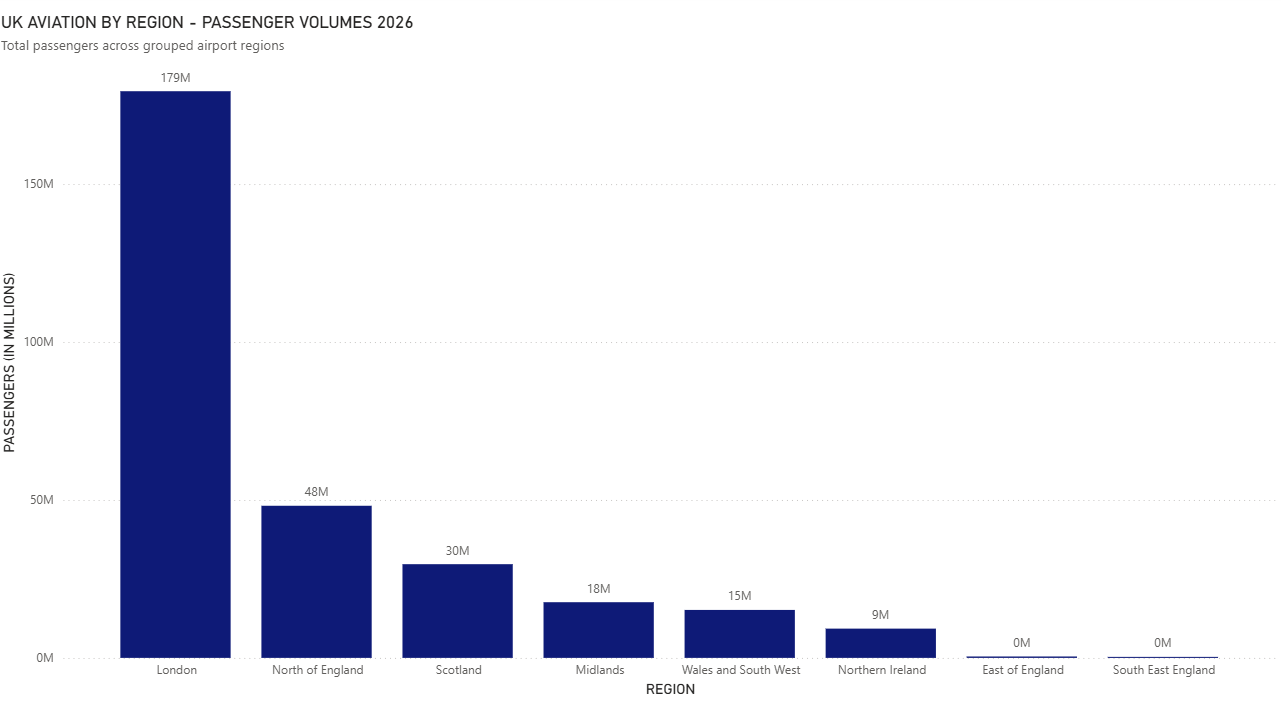
The regional breakdown of UK aviation is stark. London’s six airports collectively handle 179.4 million passengers — 59.8 per cent of the national total — from a city that contains 13 per cent of the UK’s population. The North of England’s five main airports handled 47.9 million passengers between them: Manchester, Liverpool, Newcastle, Leeds Bradford and Humberside, combined, could not fill Heathrow’s seats twice over.
Scotland’s picture is more nuanced. Edinburgh’s surge to 17 million passengers is genuinely impressive, and Prestwick’s 15.3 per cent growth adds another positive note. But Aberdeen’s marginal decline and the pressures on the remote island airports cast a shadow over the otherwise encouraging headline numbers.
Four passengers, two planes, and the airports that exist because communities have no other choice
At the bottom of the CAA table sit airports that bear almost no resemblance to the glass-and-steel temples of Heathrow or Gatwick. Lydd Airport in Kent recorded just four passengers in the entire reporting period. Oxford (Kidlington) recorded 73. Lerwick (Tingwall) in Shetland handled 2,722. These are not commercial failures. They are, in most cases, either specialist private aviation facilities or — particularly in Scotland — airports serving remote island and highland communities where the plane is not a luxury. It is a bus.
Wick John O’Groats, serving one of Britain’s most remote mainland communities at the very tip of Caithness, recorded the sharpest real-terms decline of any airport in the dataset: down 36.8 per cent, from 9,846 passengers to 6,227. Sumburgh in Shetland fell 4 per cent. Benbecula, on the Outer Hebrides, declined 1.5 per cent. These are not statistics. They are the sound of a community’s connection to the rest of Britain becoming quieter.
"When a remote airport loses 37% of its passengers, it is not an aviation story. It is a public health, economic access and social equity story."
FOR REMOTE COMMUNITIES
If your local airport is on the declining list, the time to engage with your MP, your council and your regional transport authority is now — not after routes are cancelled. Public Service Obligation routes exist specifically to protect essential air links. Make the case for yours before the data makes it for you, too late.
FOR POLICYMAKERS
The CAA data provides the clearest possible evidence base for where intervention is needed. Wick, Sumburgh, Benbecula and Lerwick are flagging distress signals in this data. Structured PSO funding reviews should be triggered by declines of this magnitude — automatically, not after lobbying.
Who controls British skies — the market share picture
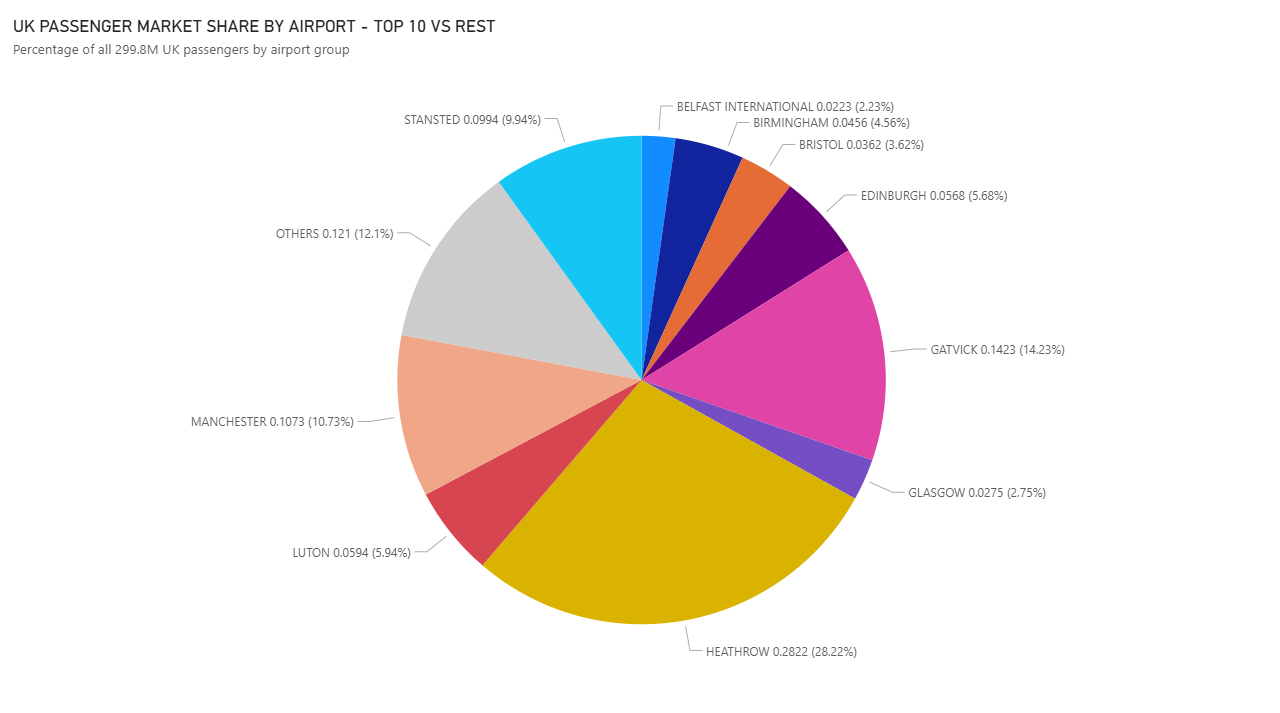
The market share chart is perhaps the single most useful visualisation of the structural challenge facing UK aviation policy. The top three airports — Heathrow, Gatwick and Manchester — between them account for 53 per cent of all UK passenger journeys. Add Stansted and Luton and the figure rises to 69 per cent, controlled by just five airports. The remaining 37 airports share the remaining 31 per cent.
This is not inherently a problem — concentration enables scale, and scale enables long-haul routes and international connectivity that benefit the whole country. But it does mean that any disruption to the top five airports has disproportionate consequences for UK air travel as a whole. It also means that the 31 per cent served by smaller airports often face higher fares, fewer routes, and less frequent services — a premium imposed not by economics, but by geography.
Actionable takeaways from the data — by audience
IF YOU ARE A FREQUENT FLYER
Check Bournemouth, Exeter, Southend and Edinburgh before defaulting to Heathrow or Gatwick. Growing airports are actively adding routes and competing on price. Set fare alerts for your nearest regional airport — it may already serve your destination.
IF YOU WORK IN REGIONAL DEVELOPMENT
Teesside (+14.3%), City of Derry (+19.3%), Cardiff (+10.1%) and Bournemouth (+27.6%) are data-backed investment stories. Use these numbers in funding bids, tourism strategies and economic impact assessments. The CAA data is primary source — cite it directly.
IF YOU MANAGE CORPORATE TRAVELL
Revisit your airport hierarchy. Edinburgh, Manchester and Birmingham are all outgrowing the London mega-hubs and offer increasingly competitive corporate pricing. Gatwick’s decline warrants a route-level review of your most frequent corridors.
IF YOU LIVE NEAR A DECLINGING AIRPORT
Wick, Dundee, Newquay, Benbecula and East Midlands are the airports most at risk of further route reduction. Community-level advocacy, coordinated with local authorities, has a track record of protecting PSO routes. Organise early.
The 2026 CAA airport size data does not tell a single story. It tells 47 of them — one for each airport in the dataset, and a different one again for every community, business and passenger whose life those airports touch. The aggregate headline, nearly 300 million passengers and 2.16 per cent growth, is cause for genuine optimism about the health of UK aviation. The detail beneath it is more complicated, more urgent, and in places more troubling.
Edinburgh is a genuine success story. Southend is a surprise worth watching. Manchester, Liverpool and Leeds Bradford are building a credible northern aviation ecosystem that, for the first time in decades, offers travellers north of Birmingham a real reason not to head south. And Wick, Lerwick, Benbecula and Sumburgh are sending signals that, if left unread, will result in communities losing connections they cannot afford to lose.
The data is here. It is public, it is primary, and it is precise. What happens next depends on whether the people who can act on it — passengers, businesses, councils, airlines, ministers — choose to.
NOTES TO EDITORS
All passenger figures are sourced directly from the UK Civil Aviation Authority (CAA) official dataset, Table 01: Size of UK Airports, reporting period 202601, run date 19 March 2026. Year-on-year comparisons use the same reporting period from the prior year. Growth percentages are calculated from raw figures and rounded to two decimal places. Market share percentages are calculated against the total UK passenger figure of 299,768,951. Oxford (Kidlington) percentage growth (3,550%) is excluded from growth charts as statistically unrepresentative (base of 2 passengers). All analysis and interpretation is original. The CAA dataset is publicly available at caa.co.uk.
ABOUT THIS ANALYSIS
This press release and data analysis was produced as an independent examination of publicly available UK Civil Aviation Authority data. It is intended to serve passengers, businesses, communities, policymakers and aviation industry professionals with an accurate, accessible and actionable interpretation of the official statistics. It may be freely cited with attribution.
Media Enquiries & Licensing
Journalists wishing to use charts, tables or analysis from this report are welcome to do so with attribution.
For persona-specific briefings — traveller, corporate, regional, policy or industry angles — tailored pitch documents are available on request.
Data Source: UK Civil Aviation Authority — caa.co.uk
Reporting Period: 202601 (Year to January 2026)
Data Run Date: 19 March 2026