How digital PR became the smartest way to build links.
Cold outreach for links is losing to earned coverage. Here's the data on why digital PR now outperforms traditional link building — for Google, and for AI search.
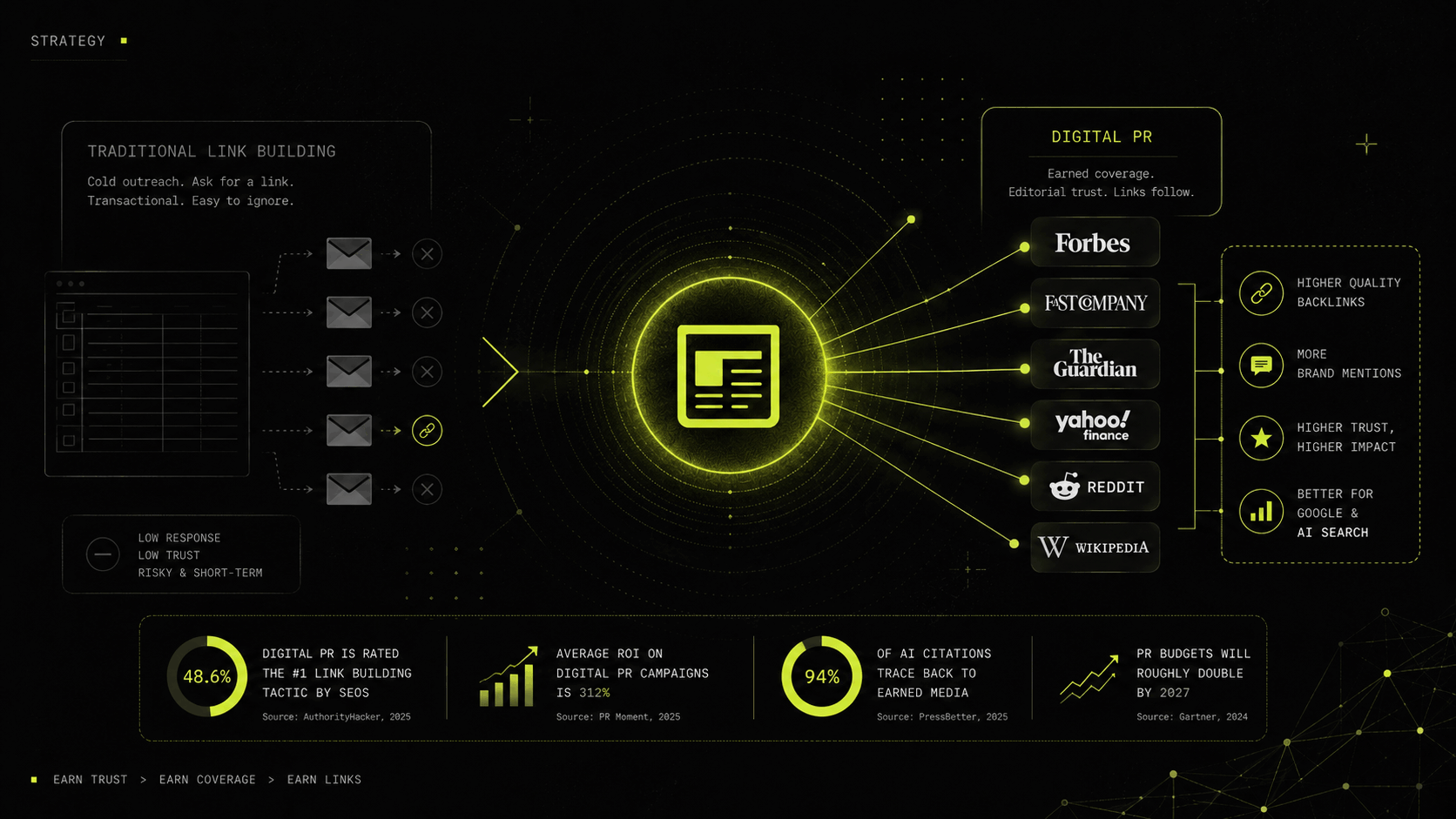
For a decade, "link building" meant the same grind: find a site in your niche, send a cold email, ask for a link — sometimes offer one back, sometimes offer money and hope nobody notices. It's not that this stopped working entirely. It's that a quieter, harder-to-fake alternative started outperforming it on every metric that matters: earning the coverage first, and letting the link follow as a side effect of a story someone else genuinely wanted to run.
The short version: digital PR is now rated the single most effective link-building tactic by 48.6% of SEOs — more than three times the next-best tactic, guest posting, at 16%. Average reported ROI on digital PR campaigns runs around 312%. And the reason it's not slowing down: 94% of AI citations trace back to earned media rather than paid or brand-owned content, and Gartner has predicted earned-media and PR budgets will roughly double by 2027 specifically because AI search depends on it.
Google told you this was coming
Google has spent the last two years publicly walking back how much it wants you to think about links. Google's Gary Illyes has said outright that the algorithm "needs very few links" to rank a page, and the word "important" was quietly removed from Google's own documentation about links in March 2024. Meanwhile, the spam side of the equation got a lot less forgiving — Google's SpamBrain system now catches roughly 200 times more spam than it did at launch, and successive 2024–2026 spam updates have specifically targeted the guest-post-for-links and private-blog-network patterns that used to be link building's bread and butter.
None of that means links stopped mattering for ranking — the correlation between backlinks and top positions is still real; pages in the #1 spot still average roughly 3.8x more backlinks than positions two through ten in large studies. What changed is the source. Google is rewarding links and mentions that come from genuine editorial judgment, and getting sharper every year at discounting the ones that came from a transaction.
Two goals, one campaign
Here's the part that makes digital PR different from either old-school link building or plain brand awareness work: it's the only tactic that serves both of the systems a brand actually needs to win with today, at the same time. Classic Google ranking still correlates with backlinks. AI citation correlates far more with being mentioned — reviews, press, forum threads, roundups — whether or not that mention carries a followed link. A pure outreach campaign built to harvest links does nothing for the second system. A genuine press placement does both: it earns a link a journalist chose to include, and it puts your name, unlinked or not, into exactly the kind of independent, third-party context that AI systems are built to trust.
It rewards a system, not a sprint
The data here is unambiguous: brands running consistent, ongoing digital PR campaigns earn 3 to 5 times more high-authority links than brands that run one-off outreach pushes and stop. That tracks with how journalists actually work — a publication that's covered your data once is far more likely to come back to you as a source next time, and a steady cadence of genuinely newsworthy angles builds the kind of relationship no single outreach email can. Sporadic, one-off campaigns are consistently the weakest performers in the category, which is exactly why the tactic rewards treating it as infrastructure rather than a quarterly project.
What actually earns the placement
Not every "digital PR campaign" performs the same. Original research and proprietary data are the strongest-performing asset category by a wide margin — 42.3% of successful campaigns are built around original data, because a dataset a journalist can't get anywhere else is the single hardest thing to say no to. Right behind it: reactive expert commentary, the HARO-style practice of responding fast and credibly to a journalist actively looking for a quote — rated the single best-performing digital PR tactic by 35.3% of practitioners, mostly because speed plus real credibility beats a beautifully written pitch that arrives a day late.
"Build something genuinely worth linking to or quoting — data, tools, expert commentary — then get it in front of the people who'd naturally cite it."
The bar is rising, and that's the point
The honest caveat: digital PR is getting harder, not easier, to do well. The market itself is growing fast — estimated at $7.67B in 2025, $8.14B in 2026, and projected to reach $11.55B by 2034 — which means more brands are competing for the same journalists' attention. 68.2% of PR professionals say the tactic is more effective than it was a year ago, but 75% also say it's become more challenging to execute. The spray-and-pray version — generic pitches to long, unsegmented media lists — has stopped working. What's replacing it is narrower, more original, more data-backed pitching aimed at fewer, better-fit journalists. That's a harder job than sending more emails. It's also why it keeps working for the people willing to do it properly.
The practical read
If a link-building plan for 2026 still starts with a spreadsheet of sites to email and ends with a link as the entire deliverable, it's solving half of a problem that now has two halves. The version that earns both a real backlink and a mention AI systems will actually surface starts with a story worth running — a dataset, a fast expert quote, a genuinely useful resource — and lets a journalist's own editorial judgment do the rest.