Why AI recommends some brands and ignores others.
ChatGPT, Perplexity, and Google's AI Overviews don't rank pages — they pick names. Here's what the research says actually decides whether yours is one of them.
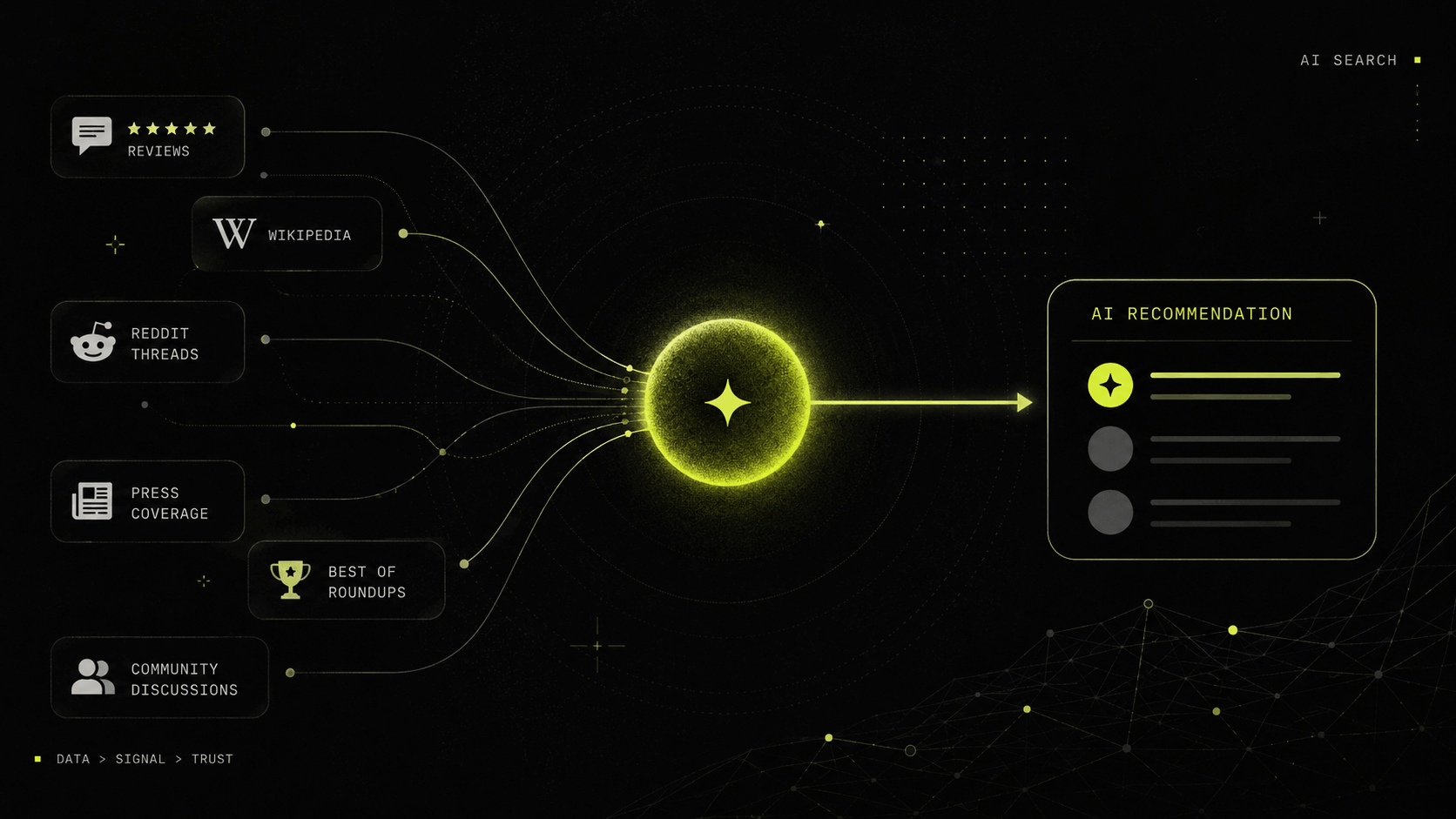
Type a question into ChatGPT, Perplexity, or Google's AI Overview and you don't get ten blue links to sort through — you get one answer, with a handful of names in it. Search stopped being a contest for position eleven years running and became a much blunter contest: named, or not named. In the first four months of 2026, Google searches in the US ended without a single click 68% of the time, according to SparkToro's analysis of Similarweb clickstream data — the answer increasingly is the destination. So the question worth asking isn't "how do I rank higher." It's "why does the model say my name at all."
The short version: AI systems weight independent corroboration — reviews, roundups, Wikipedia, Reddit threads, press coverage — far more heavily than anything a brand publishes about itself, because third-party proof is harder to fake. Princeton's 2024 GEO-bench study found that content citing sources, quoting data, and written in an authoritative, statistic-dense style was cited 30–40% more often by generative engines than unoptimized content, across roughly 10,000 test queries. And per SparkToro's own January 2026 test, asking an AI model to recommend brands in a category 100 times returns the same list fewer than 1 time in 100 — so the real goal isn't "rank #1 in ChatGPT." There is no #1. The goal is showing up often enough, from enough independent angles, that you're in the rotation.
It's retrieval, not ranking
Classic SEO optimized one system: a crawler indexes your page, an algorithm scores it against a query, you get a position. AI answers are built differently. Most tools blend two things — what the model already "knows" from training (which brands, in which contexts, appeared often enough in its training data to be encoded as a known entity) and what it retrieves live from the web when it answers a specific prompt. Getting recommended means winning both: being represented well enough in the model's underlying knowledge, and being retrievable with clean, specific, corroborated evidence at the moment someone asks.
That's also why tools like Ahrefs' Brand Radar and Semrush's AI Toolkit now track something they call "Share of Model" or AI visibility share — essentially, how often your brand shows up across a basket of real prompts, tracked over time — rather than a single ChatGPT screenshot. A model's output is closer to a probability distribution than a fixed leaderboard, so the metric that matters is trend, not a snapshot.
The randomness nobody mentions
Rand Fishkin's SparkToro research from January 2026 is worth sitting with: ask ChatGPT, Claude, or Google's AI to recommend brands in a category 100 separate times, and you'll see the identical list come back fewer than once. That's not a bug in the model — it's a fundamental property of how these systems generate answers. It also means the entire "we're the #1 AI-recommended brand in our category" framing that's started showing up in marketing decks is mostly noise dressed as a data point. There usually isn't a stable #1. There's a rotating shortlist, and the game is getting onto it more often than not.
Your own website is the weakest evidence you have
Otterly's 2026 AI Citations report found that brand-owned domains account for 52.5% of all AI citations — which means the other 47.5% goes to media coverage, reference sites, reviews, and community discussion. That's a much bigger share for third-party sources than most brands assume. It lines up with what practitioners report anecdotally: when a brand doesn't get recommended, the most common reason isn't bad content on its own site — it's absence from the places AI systems treat as independent proof: Wikipedia, G2 and other review platforms, Reddit threads, and "best of" roundups written by someone other than the brand. A glowing paragraph on your own homepage is the easiest kind of evidence to fake, so models are trained to lean on it the least. A mention inside an article you didn't write, on a site you don't own, is exactly the harder-to-fake signal they lean on instead.
Why an earned citation outweighs a self-published one
This is the same mechanic behind a decision we made with our own case study. When DataPR wanted proof of what a data-driven placement could do, we didn't just publish the analysis on datapr.co — we pitched it, and it ran as an independent feature in Aerospace Global News, a DR66 aviation outlet with no relationship to us beyond the story being genuinely worth their readers' time. That's the difference this research is pointing at: the exact same paragraph, on our own blog, is "content." The same paragraph inside someone else's editorial decision to run it is corroboration. AI systems — and, increasingly, human readers — can tell the two apart.
"The signals that matter most: entity clarity, category fit, source corroboration, freshness, and third-party trust."
So what actually moves the needle
- Get named by people who aren't you. Press coverage, genuine reviews, roundup inclusions, and community mentions carry more weight than anything on your own domain — because they can't be faked as easily.
- Make your own content worth citing. Princeton's research is specific here: cite real sources, quote real data, write in a clear and authoritative register. Vague, unsourced marketing copy is exactly what generative engines are tuned to skip past.
- Track a trend, not a screenshot. One good ChatGPT answer proves nothing. A rising Share of Model over months, across a basket of real prompts, is the only version of this metric worth reporting to anyone.
- Expect variance, and build for volume instead of a single perfect placement. Because the same query can return a different shortlist every time you ask it, consistency — more genuine stories, more independent mentions, over a longer period — beats chasing one flawless citation.
None of this is really new advice dressed up in AI language. It's the same case for earned media that's always existed — it's just that the systems deciding what gets surfaced have gotten explicit about rewarding it. Being talked about, by people who don't work for you, in places you don't own, was always the hardest kind of marketing to fake. Now it's also the kind the machines are built to trust most.