Digital PR at enterprise scale: what changes when the brand is already big.
A recognized brand doesn't need digital PR to introduce it to anyone. It needs digital PR for a different reason entirely — and 72% of businesses are increasing spend on exactly that in 2026.
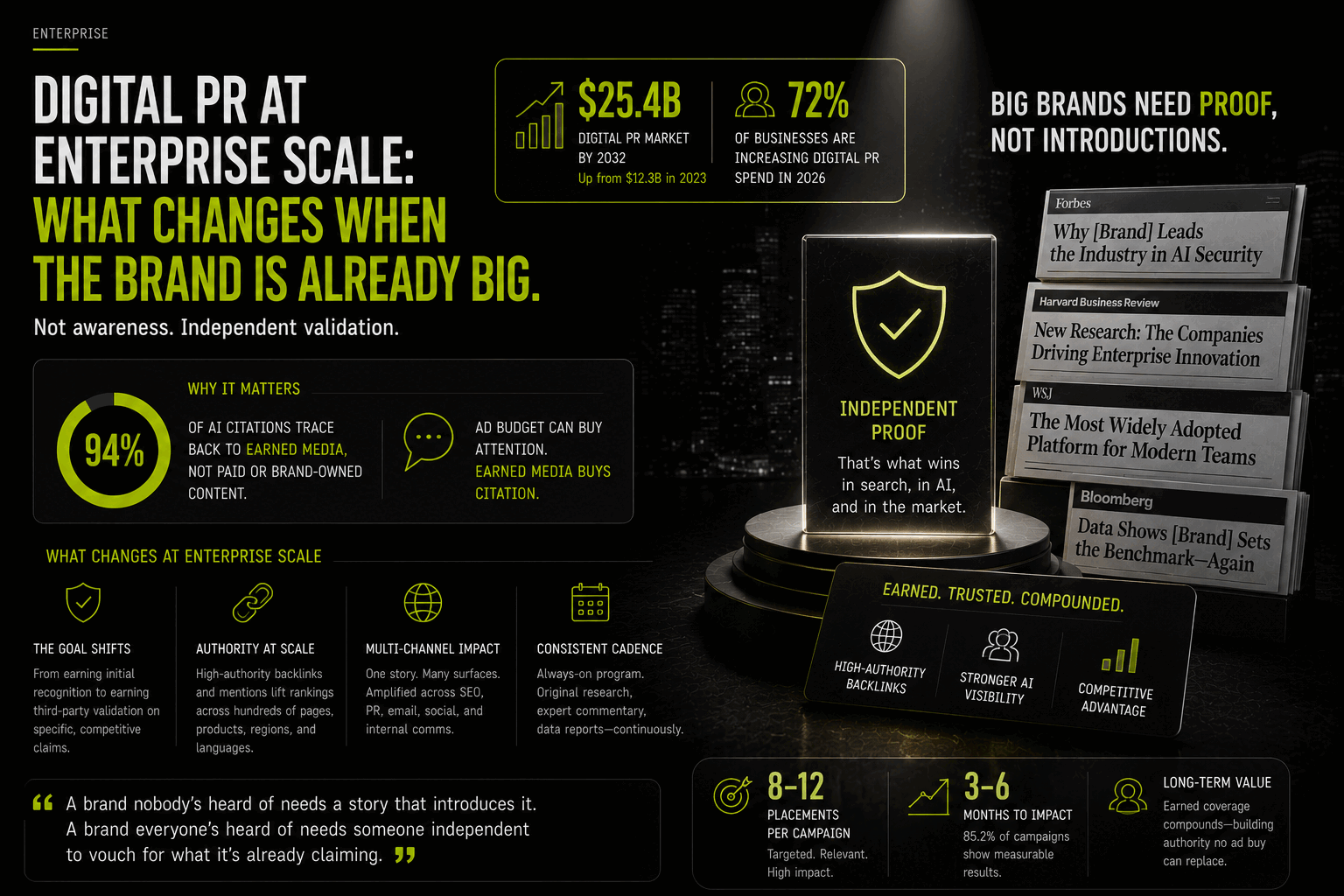
A well-known brand doesn't need a story to introduce it to anyone. Everyone already knows the name. That's exactly why digital PR at that scale gets misunderstood — the job isn't awareness anymore, and treating it like a smaller version of the same tactic misses what it's actually buying.
How big is this market getting, and why does that matter here?
The digital PR services market is projected to reach $25.4 billion by 2032, up from $12.3 billion in 2023, and 72% of businesses say they're increasing digital PR spend specifically in 2026 — growth concentrated disproportionately among companies that already have significant marketing budgets elsewhere.
That's the tell. Brands with the least need for basic awareness are the ones increasing spend fastest, which means the value they're buying isn't introduction. It's something else entirely.
What that "something else" actually is: 94% of AI citations trace back to earned media rather than paid or brand-owned content. A brand can spend an unlimited ad budget on owned channels and still be functionally invisible to the growing share of research happening inside an AI conversation — because ad spend and citation-worthy coverage are two different currencies entirely.
What actually changes about digital PR once a brand is already big?
The goal shifts from earning initial recognition to earning third-party validation on specific, competitive claims — a large brand doesn't need to be discovered, it needs independent proof for the exact comparative or authority claims its competitors are also making.
A recognized SaaS company doesn't need a journalist to explain what the product does. It needs a journalist, analyst, or independent data source backing up "fastest," "most secure," or "most widely adopted" — because at this scale, every competitor is already making the same claims in their own marketing, and only independent coverage breaks the tie.
Why does an enterprise brand need earned coverage when it already has ad budget?
Because high-authority backlinks and independent mentions help a large site rank for competitive, high-volume keywords across multiple service lines or regions at once — a scale problem ad spend can't solve, since paid placement doesn't transfer authority the way an earned citation does.
An enterprise site typically has dozens or hundreds of pages competing simultaneously across different products, markets, and languages. A single major placement can lift authority signals across that whole footprint in a way a regional ad campaign, however well-funded, structurally cannot.
What's actually different about the operating cadence at this scale?
Enterprise programs need consistent output across multiple content formats — original research, data reports, expert commentary — amplified simultaneously across SEO, PR, email, and social rather than run as a single isolated campaign, because the scale of the audience requires the same story to surface through several channels at once.
That's a materially different operating rhythm than a single-campaign engagement, and it's the reason a recurring, higher-cadence retainer model exists specifically for this kind of ongoing need — the same logic behind a monthly bundle of multiple campaigns rather than a one-off engagement, matched to a brand that needs a continuous flow of earned validation rather than a single placement.
"A brand nobody's heard of needs a story that introduces it. A brand everyone's heard of needs someone independent to vouch for what it's already claiming."
Scale doesn't remove the need for earned coverage — it changes what that coverage is proving. Smaller brands use it to become known. Large ones use it to stay believed, on the specific claims competitors are contesting every day, in a channel no amount of paid media can substitute for.