Digital PR for real estate: earning coverage that actually ranks.
93% of homebuyers start their search online, and most real estate marketing budgets still stop at the Google Business Profile. Here's the coverage that actually moves local rankings — and the data most agencies already have and never pitch.
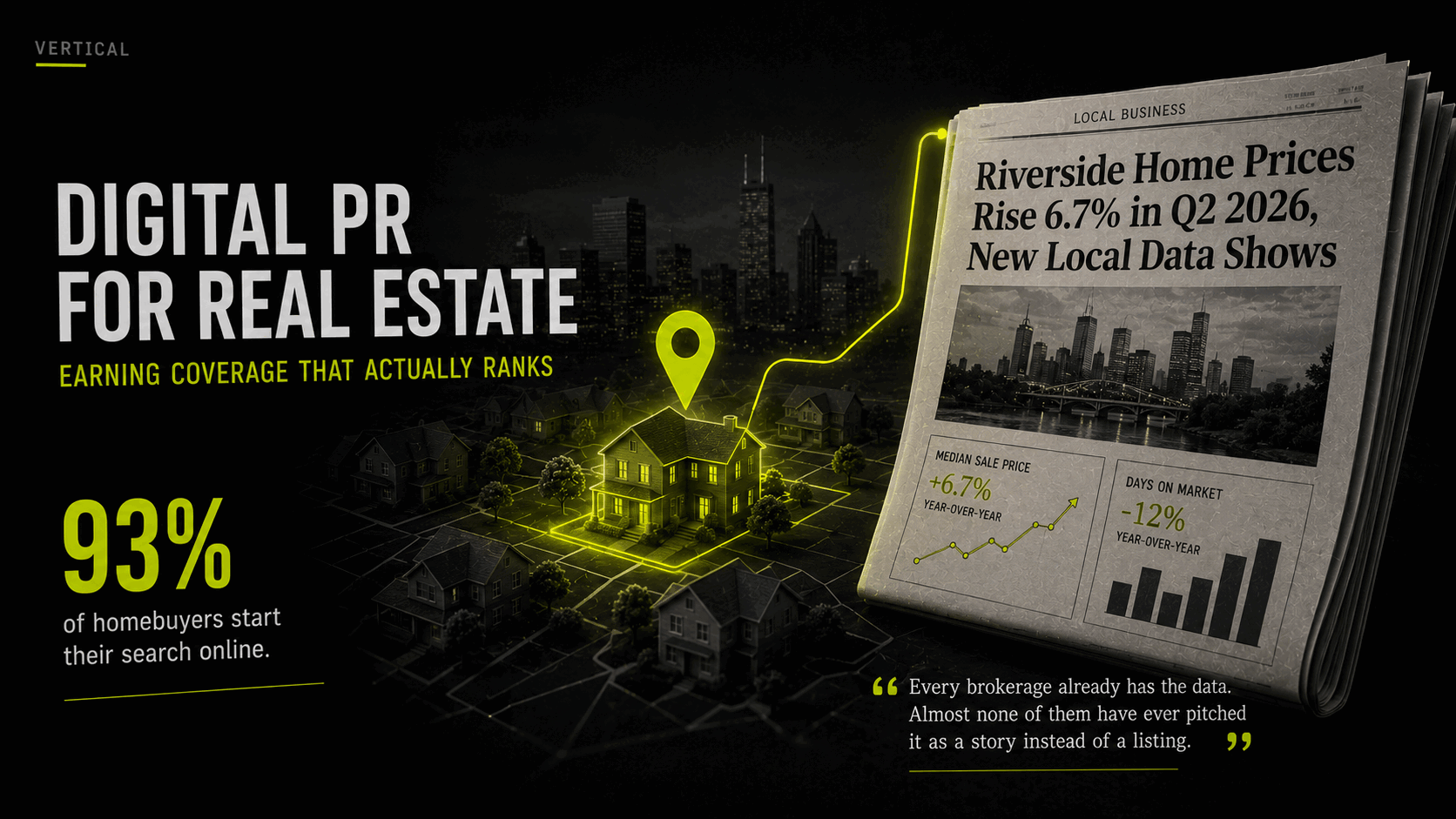
93% of homebuyers now start their search online, and real estate is projected to have one of the highest SEO returns of any industry in 2026 — yet most agencies and agents spend their entire visibility budget on the Google Business Profile and paid listings, and stop there.
Why isn't a Google Business Profile enough on its own?
A Google Business Profile controls a real share of local ranking weight — Business Profile signals alone account for roughly 32% of local pack ranking — but that's a ceiling, not a strategy, because every competing agent in the same market is optimizing the same profile fields.
Once every listing in a market has full hours, photos, and categories filled in, the profile stops being a differentiator. What's left to compete on is the content and coverage sitting around it — which is exactly where most real estate marketing budgets currently spend nothing at all.
What kind of story actually earns coverage for a real estate business?
Local market data — price trends, days-on-market shifts, inventory changes by neighborhood — is the single most reliable angle, because journalists and property analysts return to it repeatedly when they need a specific, sourceable number for a local housing story.
Most agencies already sit on this data and never pitch it. Every brokerage's own transaction history is a local market study waiting to be written — average time-to-offer by neighborhood, which zip codes are appreciating fastest, how a specific interest-rate move actually changed local buyer behavior. That's the same instinct behind turning a spreadsheet into a story journalists chase, applied to data real estate businesses already have on file.
Where the leads actually come from: neighborhood guide pages rank roughly 28% higher than generic service pages and generate 3.2 times more leads — and local market statistics pages earn more backlinks per unit of effort than almost any other real estate content type, because they give other sites a specific number to cite.
Does digital PR actually outperform other real estate marketing tactics?
Nearly half of SEO professionals — 48.6% — now rank digital PR as the single most effective link-building tactic available, ahead of directory submissions, paid listings boosts, or generic content marketing.
That ranking holds specifically because real estate has an unusually large supply of local media outlets hungry for exactly this kind of story — regional business journals, local news sites, and property-specific trade press all cover housing market shifts as a recurring beat, which means the same local data can realistically earn coverage from several outlets rather than one.
How does this actually play out in practice?
DataPR's own flagship case study followed this exact pattern in a different but comparable local-data context — a passenger-growth statistic pulled from public aviation data earned a placement in a DR66 outlet, not because the story was manufactured, but because a real, specific local number was newsworthy on its own.
The same mechanism applies directly to a local housing market: a specific, verifiable number about a specific neighborhood, timed to when local reporters are already covering the broader trend, is a pitch a regional outlet can run without any additional reporting of its own.
"Every brokerage already has the data. Almost none of them have ever pitched it as a story instead of a listing."
The agents and agencies winning local search in 2026 aren't the ones with the most complete Google Business Profile in their market — most competitors have matched that already. They're the ones whose name shows up in the local paper's housing coverage, because they were the source with an actual number when the reporter needed one.