Link building for SaaS: why directories alone stopped working.
More than two in three SaaS product pages have zero referring domains. Here's why the directory-and-listicle playbook stopped moving rankings, and what's actually earning links in 2026.
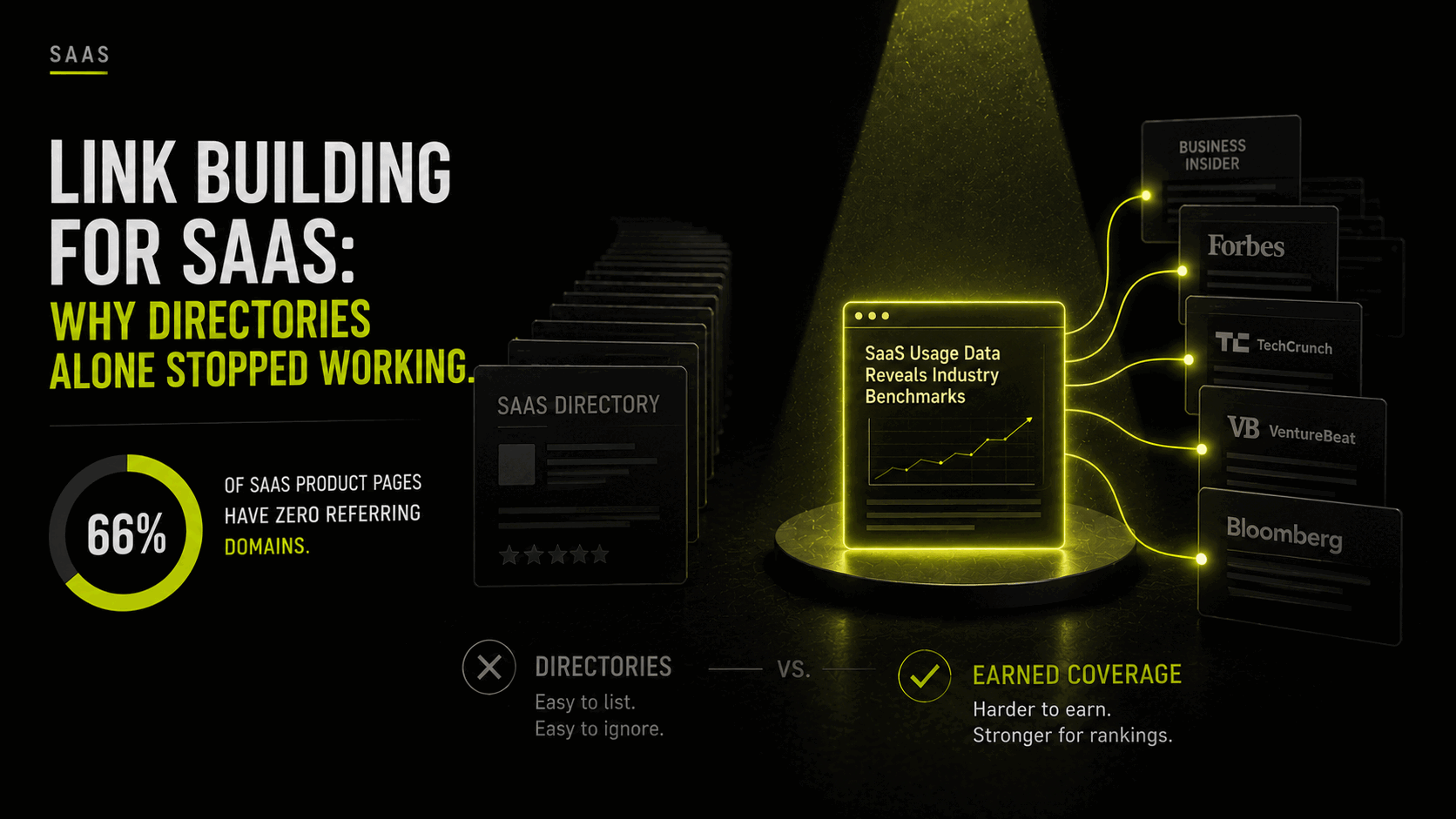
Over 66% of SaaS product pages currently have zero referring domains — not weak ones, zero. Most of those same companies have submitted their listing to every SaaS directory that exists. The two facts sit next to each other for a reason: directory submissions were never actually building authority, they were just filling out a checklist.
Why does this gap hit SaaS specifically?
SaaS companies compete almost entirely on category and comparison keywords — "best X software," "X vs Y," "X alternatives" — and those pages reward domain authority more heavily than almost any other search category, which punishes a thin backlink profile harder than it would in a less competitive niche.
The number-one ranking result across 11.8 million search results analyzed carries 3.8 times more backlinks on average than anything ranking in positions two through ten. In a category this link-sensitive, a product with genuinely better features can still lose the ranking to a competitor with a stronger backlink profile and a weaker product.
The traffic math behind this: 94.3% of all web pages get zero organic traffic from Google, and the single biggest reason is having no external backlinks at all. Pages with even one legitimate backlink are 77% more likely to reach the first page than pages with none — and sites carrying 30 to 35 genuinely high-quality backlinks average more than 10,500 organic visits a month.
Do free tools and templates still work as link magnets in 2026?
Yes, but only the ones built as genuinely standalone resources — a free calculator, template, or benchmark tool earns links passively over time specifically because other sites reference it as a resource, not because it mentions the product.
The SaaS companies still getting real mileage from this tactic in 2026 built something useful enough to exist independent of the sales pitch — an ROI calculator, an industry benchmark report, a free version of an internal tool. The ones that stopped working were thinly-disguised lead magnets with the product's name in the URL and nothing else behind it.
Where does digital PR actually fit for a SaaS company specifically?
The strongest angle most SaaS companies already have and rarely pitch is their own product usage data — aggregate, anonymized numbers about how customers actually use the tool, which double as an industry benchmark no directory listing could ever provide.
A project management tool sitting on aggregate data about how long the average team takes to close a sprint, or a CRM with real numbers on how sales cycles shifted this year, has exactly the kind of proprietary number a journalist can build a story around — the same instinct that earns the 700+ and 800+ backlink results other data-led campaigns have landed. The B2B SaaS sector as a category has posted a 702% return on this kind of investment, well above most other digital marketing spend.
Does this matter for AI-driven buying decisions too, not just Google rankings?
Increasingly, yes — SaaS buyers are now asking ChatGPT and Perplexity to recommend tools directly, and what gets recommended follows the same trust signals that earn a strong backlink profile, not a separate set of rules.
A product with genuine third-party coverage — reviews, data citations, press mentions independent of its own marketing — has a real advantage in that recommendation, because a model synthesizing "best tool for X" is weighing the same independent validation a backlink represents in traditional search.
"A directory listing says a product exists. A journalist citing your data says it's worth paying attention to. Only one of those is a link Google actually rewards."
The SaaS companies fixing this gap in 2026 aren't submitting to more directories. They're looking at the data they already collect from their own product and asking, for the first time, whether it's a story instead of just a dashboard.