Digital PR for coaches and consultants: turning expertise into press.
A potential client now asks ChatGPT who the best coach in their niche is before they ever type anything into Google. Here's what actually earns a name a place in that answer.
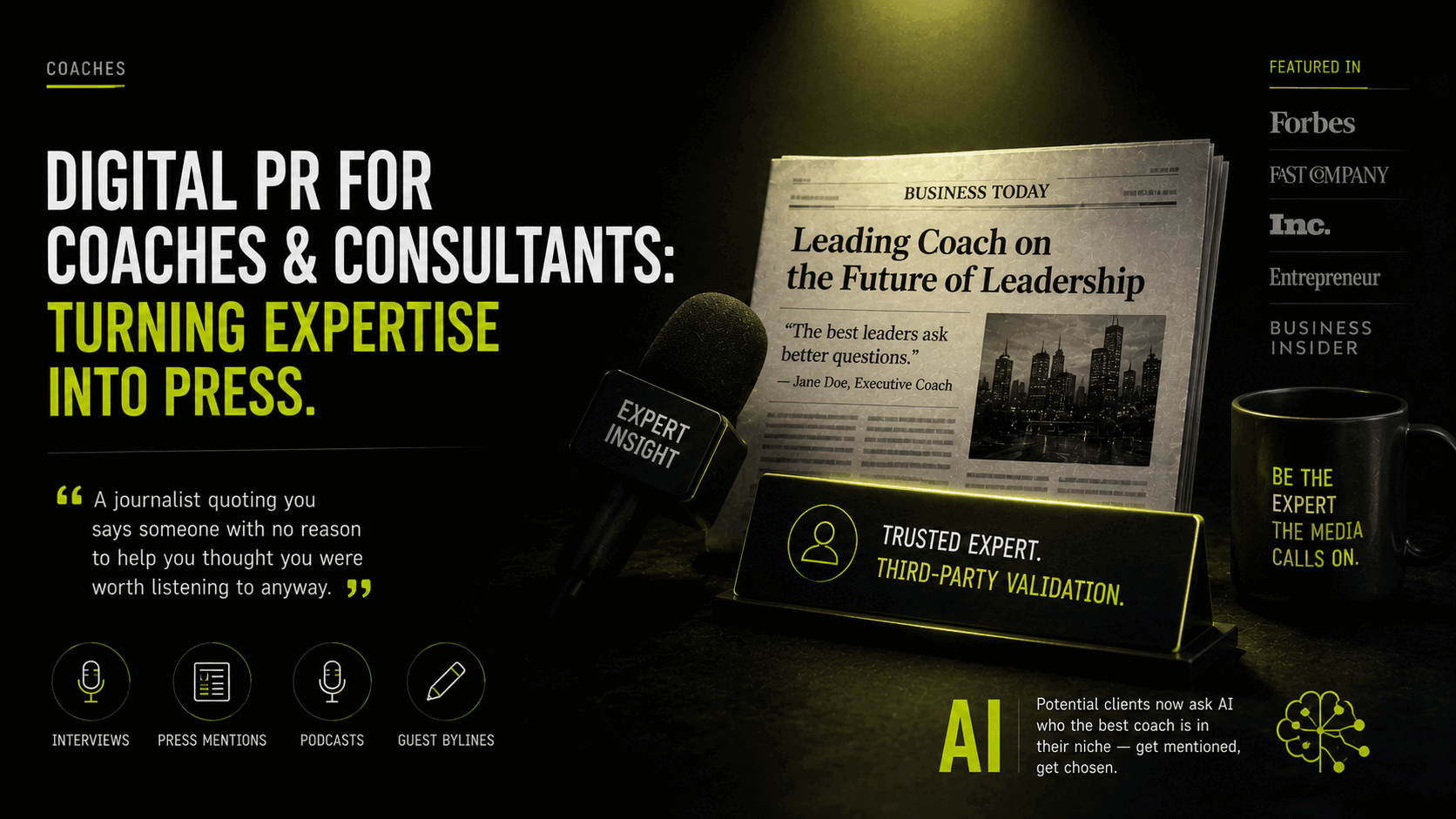
A coach's product is themselves — no packaging, no feature comparison, nothing to screenshot. That makes traditional marketing oddly hard to point at, and it's exactly why press coverage matters more here than in almost any other category: it's third-party proof that someone besides the coach thinks they're worth listening to.
Why does this category need PR more than most small businesses?
A coach or consultant is selling trust in a person, not a specification sheet, and trust transfers fastest through someone else's endorsement — a journalist's byline, a podcast host's introduction, a publication's decision to quote them — rather than through the coach's own marketing copy.
Visibility has also gotten harder and more competitive across this entire space in 2026, at the same time as the actual mechanism for being found has started to change underneath it.
What does "AI visibility" actually mean for a coach specifically?
Potential clients increasingly ask ChatGPT or Perplexity directly who the best coach or consultant is in a given niche, rather than searching Google and clicking through ten listings — which means getting recommended inside that answer is becoming as important as ranking ever was.
That shift changes what's worth building. A model answering "who's the best executive coach for first-time founders" is synthesizing from whatever it can find — press mentions, quoted commentary, articles that treat the person as a credible source. A polished personal website with no third-party coverage behind it gives a generative engine almost nothing to cite, the same dynamic covered in why AI recommends some brands and ignores others.
What PR actually gives a coach that marketing can't: credibility built through interviews, podcast appearances, expert quotes in other people's articles, and guest bylines — proof supplied by someone else's editorial judgment, which is precisely the kind of signal a generative engine weighs most heavily when deciding who to recommend.
What actually earns a coach press coverage, when there's no product to review?
A specific, opinionated take on something already in the news — commented on quickly, in the coach's actual area of expertise — earns coverage far more reliably than a general pitch about the coach's own program or philosophy.
Journalists covering workplace trends, leadership, or personal development are constantly looking for a sharp quote to attach to a story they're already writing, not a new program to promote. That's the same reactive window covered in the 24-hour window that decides who gets quoted — a coach who reacts fast, with a genuinely specific opinion rather than a generic soundbite, gets used. One who pitches "here's my program" gets deleted.
Where does the personal brand end and the earned credibility begin?
They're not really separate things by the time it works — a personal brand built entirely on self-published content reads as marketing, while the same expertise, filtered through a journalist's or podcast host's independent decision to feature it, reads as validated.
That's the entire distinction a pitch has to clear, and the reason what makes a journalist actually reply matters more for this category than almost any other — a coach only has their expertise and their timing to offer, no product news, no funding announcement, nothing else to lean on.
"A testimonial says a client liked working with you. A journalist quoting you says someone with no reason to help you thought you were worth listening to anyway."
The coaches and consultants pulling ahead in 2026 aren't necessarily the ones with the best-designed website. They're the ones a journalist could find, on short notice, with something specific enough to say — which is a much narrower, much more ownable thing to actually go build.