The 24-hour window that decides who gets quoted.
Journalists don't wait for the perfect pitch. They wait for the next deadline. Here's how the reactive-PR window actually works, and what it takes to be ready when it opens.
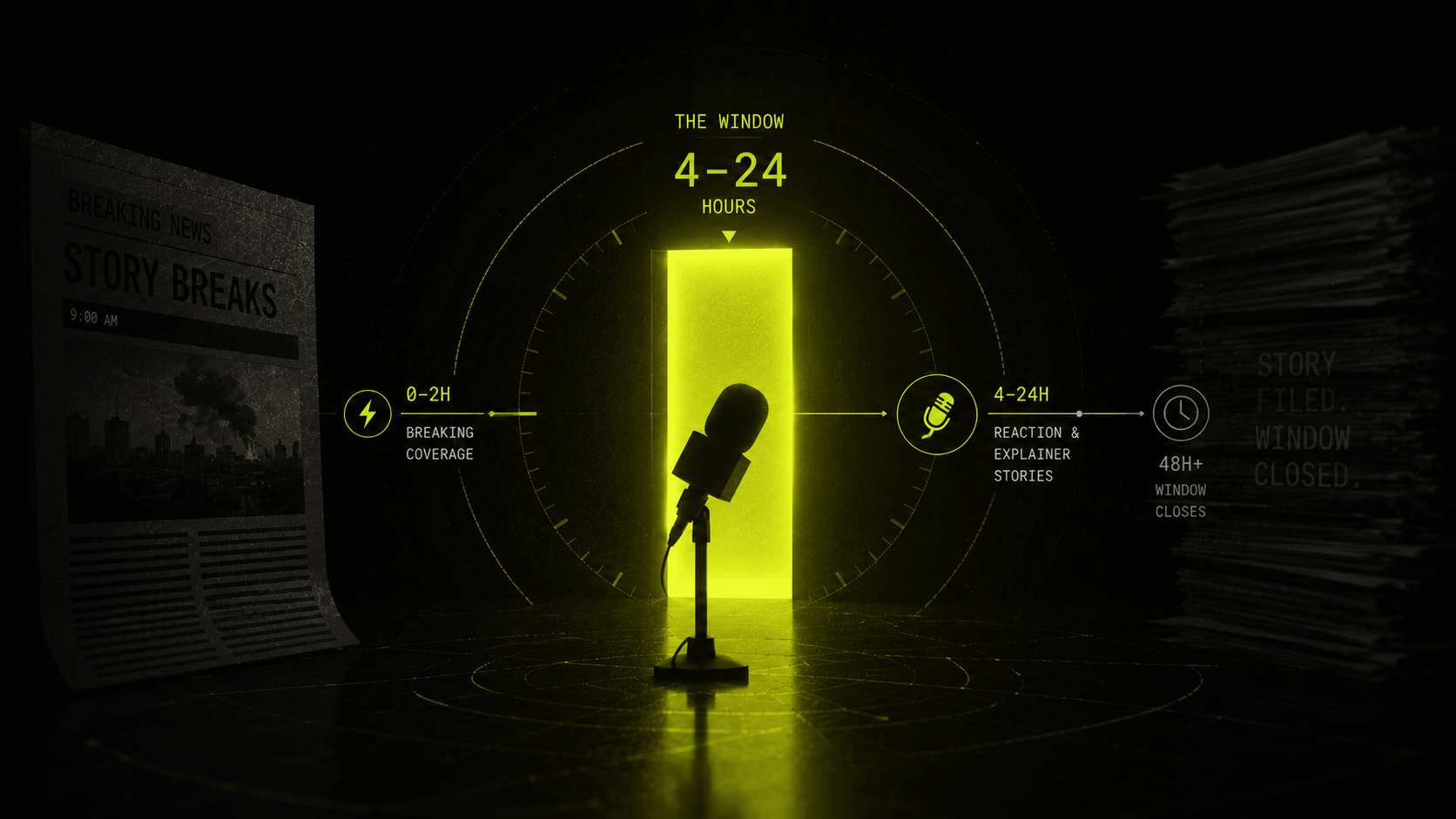
A story breaks at nine in the morning. By lunchtime, a reporter is already writing the follow-up — the piece that explains what it means, who it affects, what happens next. That second article is where an outside brand gets to appear as a source. Miss the window, and the story runs without it; somebody else's quote fills the gap instead.
The short version: the useful window for reactive commentary runs roughly 4 to 24 hours after a story breaks, and it's largely closed by 48. Muck Rack's 2026 survey of working journalists found 82% want a genuine subject-matter expert as a source, against just 8% who'll accept a self-appointed one — and most pitches get rejected for being irrelevant, not for being badly written. Relevance and speed beat polish, almost every time.
The story breaks twice
Every newsworthy event produces two waves of coverage: the breaking story itself, filed in the first hour or two by whoever's closest to the wire, and a second wave of explainer and reaction pieces that follows over the next day. Reactive PR — newsjacking, if you want the sharper word for it — lives almost entirely in that second wave.
The first article rarely quotes an outside source; there isn't time to find one. The second is often built largely out of outside commentary, because the reporter writing it already has the facts and now needs someone to explain what they mean. That's the piece a brand can actually get into. Not by beating the news, but by being ready the moment the follow-up assignment lands on someone's desk.
The window is real, and it's short
Journalist sourcing behavior clusters tightly around a 4-to-24-hour stretch after a story publishes — the period when reporters are actively hunting for fresh quotes and supporting data for the next piece. By the 48-hour mark, most of them have filed and moved on to whatever's next.
One UK finance firm built a reputation on exactly this. When a well-known retailer headed toward insolvency, its spokesperson had commentary in front of reporters within a couple of hours of the news landing, while competitors were still deciding who should respond. The quote itself wasn't unusual. Showing up while the assignment was still open was.
What actually makes a two-hour turnaround possible
Fast reactive commentary isn't a talent some PR people happen to have. It's four pieces of infrastructure, built before any story breaks: a monitoring setup that surfaces relevant news the same hour it happens, a spokesperson who's already cleared to speak without a fresh round of internal sign-off, a pitch structure that only needs the day's specific angle dropped in, and a running sense of which reporters at which outlets actually cover this beat.
None of those four things can be assembled after the news has already broken — that's the whole point. Teams that respond in two hours aren't faster writers than everyone else. They already had three of the four pieces sitting ready before they knew what today's story would be.
"The pitch that wins is rarely the best-written one. It's the one that shows up while the assignment is still open."
Is HARO still worth using in 2026?
HARO — folded into Connectively after Featured revived the brand — still connects experts with journalists, but the signal-to-noise ratio has gotten worse. Popular queries draw hundreds of pitches within the first hour, and most sources report needing 10 to 20 attempts before one gets used.
Qwoted's free tier adds a two-hour delay before you can even see new requests, which paid subscribers skip — though approval rates there still sit around 6%. The one genuinely useful shift this year: several of these platforms can now filter out AI-generated responses before a journalist ever sees them, which raises the value of a pitch a person actually sat down and wrote. The tools are still worth the subscription for a specific expert with a narrow beat. They stopped being a mass-blast channel a while ago.
Which stories are actually worth jumping on
Not every trending topic deserves a pitch. The ones worth chasing pass a simple test: does the brand have real, checkable expertise here, and can it say something about this specific story that a generic commentator couldn't? If the honest answer is no, the right move is to sit that one out.
That restraint matters more than it sounds like it should. Since irrelevance is the top reason journalists reject a pitch, forcing a brand into a story it doesn't understand does more damage to the relationship than staying quiet for a day ever would.
What if there's no team ready to move in two hours?
Most companies' real problem isn't a lack of speed — it's that nobody owns the process. No one's watching for the relevant story, no spokesperson has standing clearance to talk to press, and by the time an email thread agrees on wording, the window has already closed. That's a staffing and process gap, not a talent one, and it's the reason reactive PR tends to work better as an ongoing practice than as something rebuilt from scratch every time news breaks.
None of this requires predicting the news. It requires deciding, before anything breaks, who's allowed to speak for the brand and how fast that answer can reach a reporter's inbox. The pitch is almost never the hard part. Being ready is.