Why unlinked brand mentions matter more than ever.
Google says it doesn't use brand mentions the way it uses links. AI search disagrees. Here's the data on why being talked about now matters as much as being linked to.
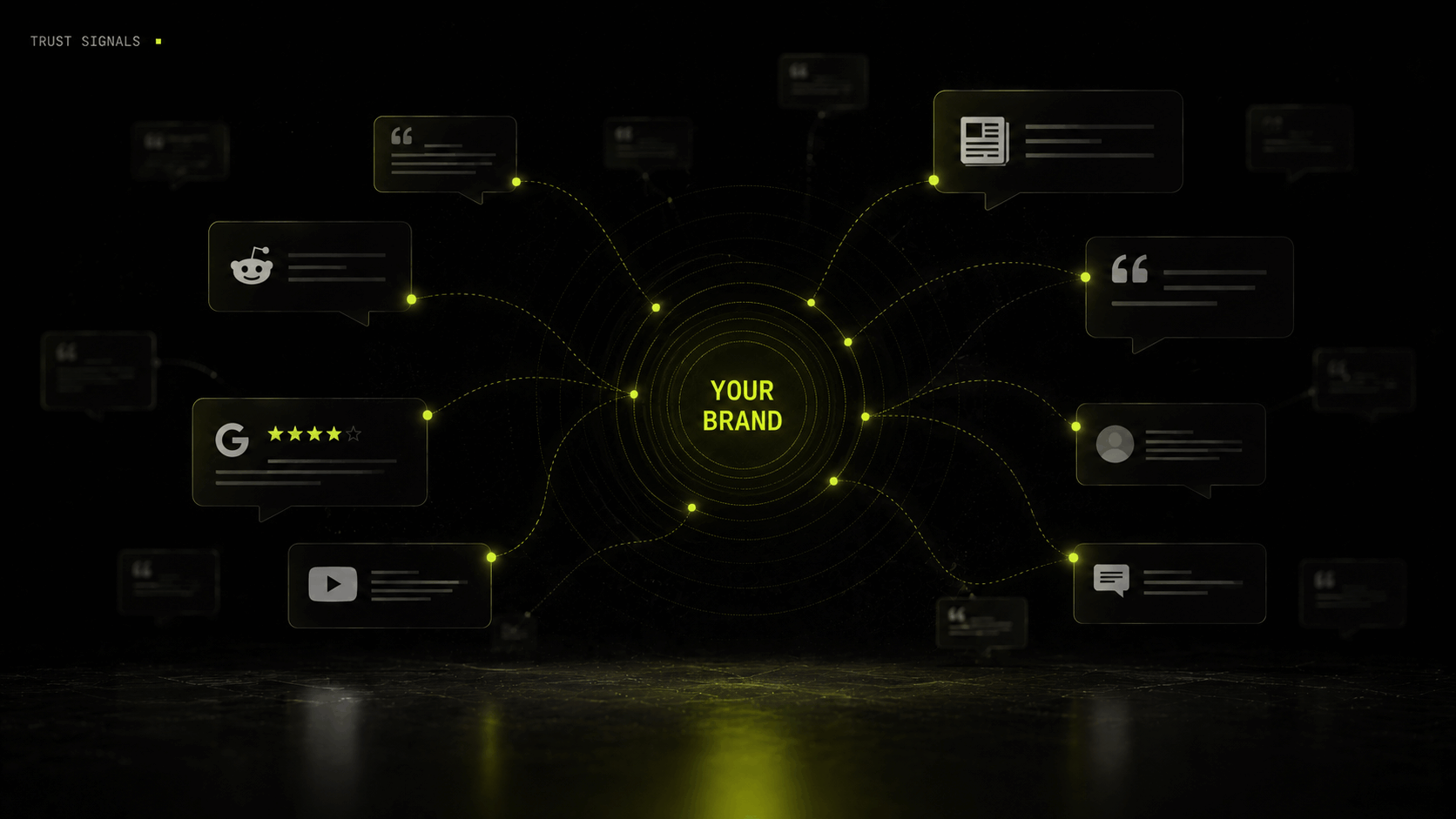
For years, the SEO rule was clean: if a mention doesn't carry a link, it doesn't count. Google's own John Mueller has said as much directly, on more than one occasion — Google does not use unlinked brand mentions for PageRank or for understanding a site's link graph. That's still true. It's also no longer the whole answer, because a second system now reads the web alongside Google's classic ranking algorithm, and it plays by different rules entirely.
The short version: for classic Google ranking, Mueller's clarification stands — unlinked mentions aren't a substitute for a followed backlink. But for AI-generated answers, the correlation data points the other way. Branded web mentions correlate with appearing in Google's AI Overviews at roughly 0.664, versus just 0.218 for backlinks — mentions are the far stronger predictor. Branded anchor text sits around 0.527, and branded search volume between 0.392 and 0.466. YouTube mentions are the single strongest predictor of all, around 0.737, across ChatGPT, AI Mode, and AI Overviews alike. Two systems, two different currencies — and most brands are still only budgeting for one of them.
What Google actually says, precisely
It's worth being exact about this rather than rounding it to a slogan. In recorded SEO Office Hours sessions, Mueller has said Google doesn't use brand mentions "for things like PageRank or understanding the link graph of a website" — but he's also confirmed Google does "pick up mentions as a mention on another website." Those two statements aren't in conflict. Google registers that you were mentioned; it just doesn't treat that mention as link equity. Where it likely does matter, by Google's own broader public statements about ranking systems, is in entity recognition inside the Knowledge Graph, in branded search volume as a trust signal, and in the general E-E-A-T picture Google builds of a brand — softer inputs, not a direct ranking lever the way a backlink is.
Why AI systems don't care about the distinction
A large language model isn't scoring a link graph at all. It's drawing on training data and live retrieval to answer a question, and what it's really measuring — however indirectly — is how consistently and credibly a brand gets talked about across the web it was trained and retrieves on. A link is one way that shows up. An unlinked mention in a genuine review, a Reddit thread, or a news article is exactly the same kind of evidence: proof that an independent third party chose to name you. That's why the correlation gap is so wide — 0.664 for branded mentions against 0.218 for backlinks isn't a rounding difference, it's a sign that these are functionally different signals for two different systems, and optimizing only for the one Google explicitly discounts (link equity from mentions) means ignoring the one that increasingly decides whether AI names you at all.
"Unlinked brand mentions now function like backlinks did — sentiment and cross-context consistency matter, not just frequency."
The Wikipedia problem
Wikipedia is the single most-cited domain by ChatGPT, and sits at #2 across all major LLMs behind Reddit. A Wikipedia entry gives a brand something powerful: a defined entity node inside a model's own knowledge, rather than a reputation assembled purely from how often other sites happen to mention it. Without one, a brand exists in a model's understanding only as strong — or as weak — as its third-party mention network makes it. Wikidata offers a lower-barrier way to establish that same entity disambiguation. It's also not a side project anymore: Wikimedia has signed enterprise API deals with Microsoft, Meta, Amazon, Perplexity, and Mistral, which means Wikipedia's role as an entity backbone for AI answers is now commercially structural, not incidental.
The part worth being honest about
Mentions are heading toward the same manipulation problem links already went through. Brands are already experimenting with flooding Reddit and review sites with manufactured mentions specifically to game AI citation, because both ChatGPT and Google's AI treat community platforms as trusted, organic opinion. One documented March 2026 experiment got a fully fictional brand, backed by a manufactured web presence, cited across all five major AI platforms within a single month — a sign that current citation-trust systems are still immature enough to be gamed. Reddit alone is now catching roughly 25,000 spammy posts a day trying to fight it. The likely next layer of defense is provenance and authorship verification — named, credentialed experts and consistent entity information that's harder to fabricate at scale than a fake review. Which is really the whole argument for doing this the earned way now, while genuine, verifiable mentions still carry a real edge over manufactured ones.
The practical takeaway
- Track mentions with the same rigor as backlinks — not just where you're linked, but everywhere you're named: press, reviews, forums, YouTube.
- Don't skip a placement because it won't link. An unlinked citation on a trusted, independent site is real evidence to an AI system, even if Google's classic algorithm shrugs at it.
- Build a real entity presence — a Wikipedia or Wikidata footprint, consistent naming and credentials across the web — rather than relying on link volume alone.
- Favor mentions that are genuinely hard to fake — named experts, real reviews, real journalism — over anything that looks like manufactured volume, since that's exactly the version of "mentions" about to face a manipulation crackdown.
The old rule — get the link, or it doesn't count — was right for the system it was written for. It's simply no longer the only system reading the web. Being talked about, by name, by someone who isn't you, is doing real work now whether or not it comes with a blue underline.