AI Overviews by the numbers: the 2026 zero-click data.
Zero-click search has been climbing for years. AI Overviews just accelerated it. Here's what the 2026 data actually shows — and what still earns visibility once the click stops being the goal.
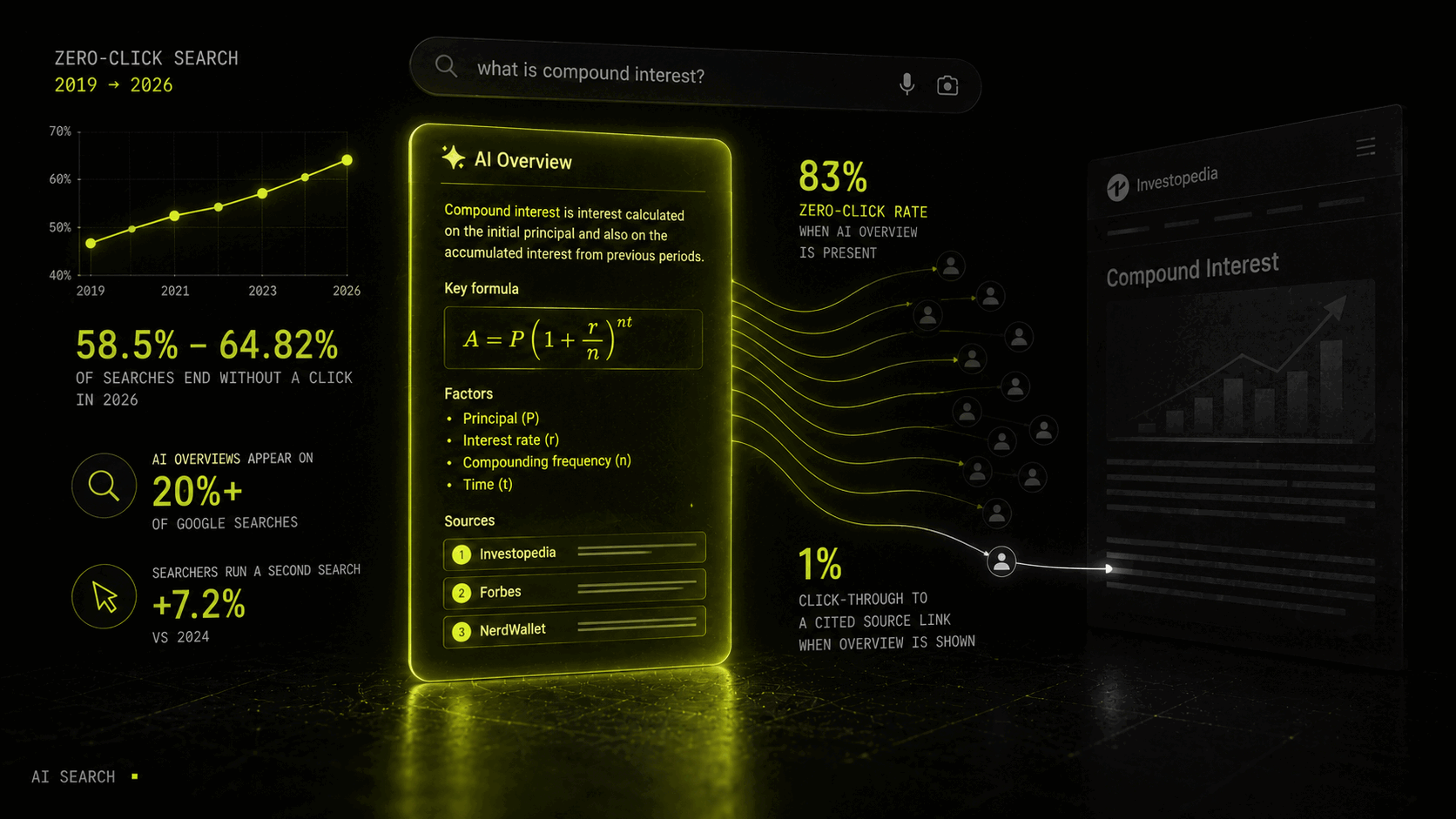
Half of all Google searches ended without a click back in 2019. By 2026, depending on whose measurement you trust, that number sits somewhere between 58.5% and 64.82%. Either way, the direction hasn't wobbled once in six years — and AI Overviews are the steepest part of the climb.
How often do AI Overviews actually show up now?
AI Overviews now appear on more than one in five Google searches, and their presence alone changes the outcome of that search more than almost any other single factor measured in 2026.
That's not a niche feature anymore. One in five is enough volume that "does this query trigger an Overview" has become a real planning question for anyone tracking organic performance, not an edge case to footnote.
What happens to click-through when an Overview appears?
When an AI Overview shows up on a search results page, the zero-click rate for that query jumps to 83%, compared with 60% on the same kind of query without one — and overall organic click-through drops by an average of 18%.
Eighty-three percent is worth sitting with. On a query where an Overview appears, roughly five out of six searchers now get their answer without visiting any site at all, including the ones the Overview is citing.
The number that stings most: when an AI Overview is shown, people click through to a cited source link only about 1% of the time. Being the source Google's AI quotes and being the page someone actually visits have become two almost entirely separate outcomes.
Does this mean SEO is dying?
No — it means the metric that used to define success is no longer the only one that matters, because visibility and traffic have split into two different things that both require a strategy.
A brand can be the exact source an AI Overview cites, in front of a huge share of searchers, and see almost none of them land on the actual page. That's not a broken result. It's a different kind of result — closer to a magazine feature that builds recognition than a coupon that drives a same-day visit. Measuring only click-through against 2019 expectations will make 2026 performance look like failure when it's actually working exactly as the format now works.
What still earns visibility once the click isn't the point?
Original data, named experts, and first-hand specifics are what generative engines actually pull into a synthesized answer — the same qualities that separate brands AI recommends from brands it ignores entirely in the citation research already published on this data.
That's also the throughline connecting AI visibility to earned coverage rather than owned content: a synthesized answer is built from sources the model judged credible enough to draw from, and a journalist's byline on a data-backed story is exactly the kind of signal that judgment rewards. Nobody optimizes their way into that trust with on-page tags alone.
Are people searching less, or just clicking less?
Neither, exactly — the share of searchers who run a second search instead of clicking anywhere rose by 7.2 percentage points between 2024 and 2026, meaning search volume itself is holding, but more of it now stays inside the search results page.
That reshapes what "ranking" is even for. A page built to answer the first, broad version of a question competes for an Overview citation. A page built to answer the sharper follow-up question — the one a searcher types next, once the basic answer is already covered — is still competing for an actual click, because that's the query with no easy synthesized answer yet.
"The click used to be the whole transaction. In 2026, it's just one possible outcome of being visible — and often not the most valuable one."
None of this is an argument for giving up on organic traffic. It's an argument for tracking citation and mention alongside it, because a strategy measured only in clicks is now blind to most of where visibility actually happens.