SEO vs. GEO vs. AEO: what each one actually means.
Three acronyms get thrown around like they're competing strategies. They're not. Here's what each one is actually responsible for, and why you need one before you can use the other two.
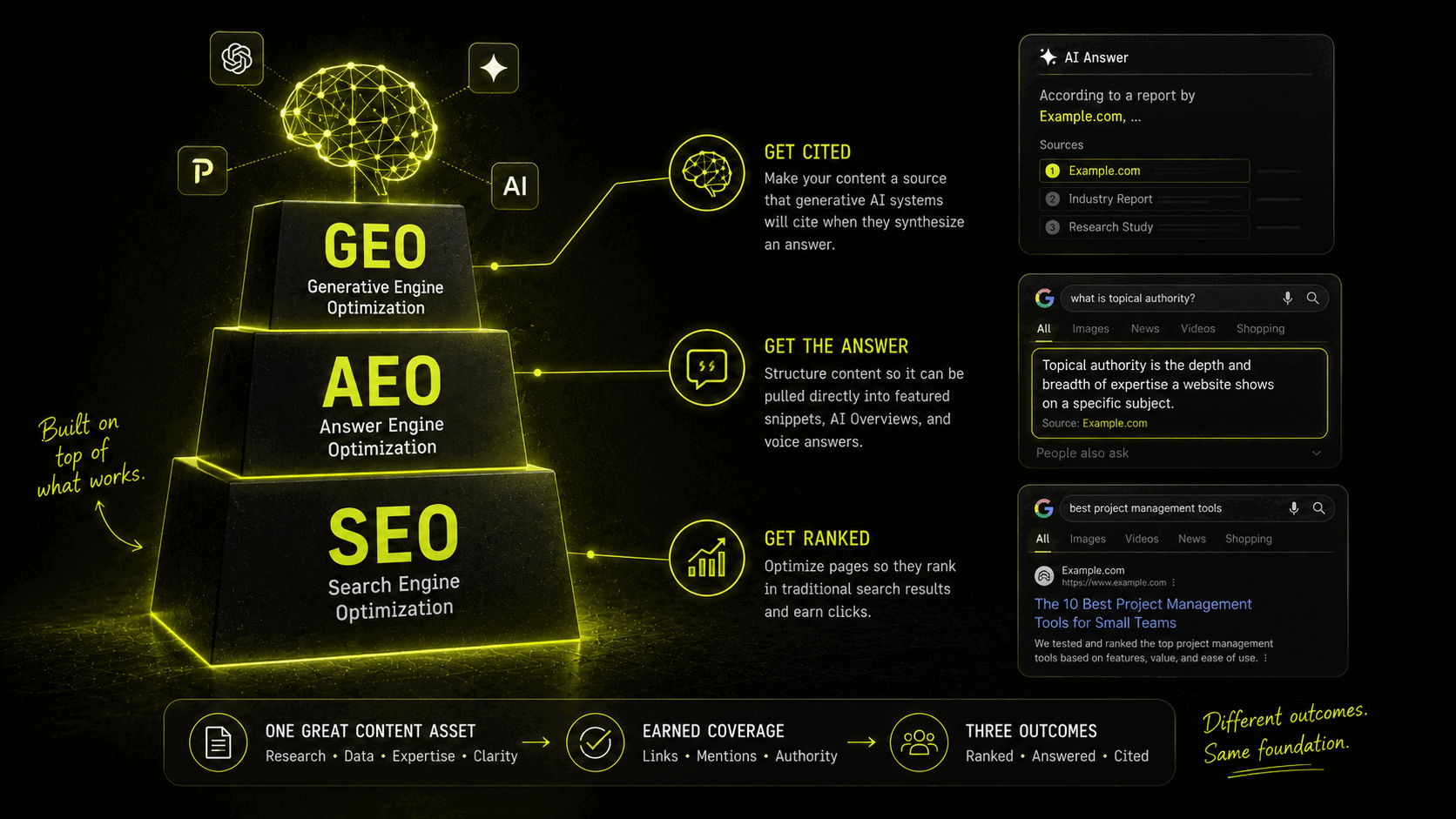
A client asked, on a call last month, whether they should "switch from SEO to GEO." That question doesn't quite parse, and it's worth explaining why before going any further — because the three acronyms aren't three competing strategies. They're three different jobs, stacked on top of each other.
What is SEO, in plain terms?
SEO is the practice of ranking a page in traditional search results — Google, mostly — using keywords, backlinks, technical structure, and authority signals, with a click as the goal.
This is the oldest of the three and, despite two years of "SEO is dead" headlines, still the foundation the other two sit on. AI systems don't crawl a parallel internet. They read the same pages Google indexes, weighted by many of the same authority signals SEO has always chased.
What is AEO?
AEO — answer engine optimization — is structuring content so it gets lifted whole as a direct answer, inside a featured snippet, a People Also Ask box, an AI Overview, or a voice assistant's spoken reply.
The unit of success here isn't a ranking position. It's whether a self-contained sentence or short passage can be extracted cleanly and answer the question on its own, without the reader needing to click through for the rest. That's a writing discipline as much as a technical one — a direct-answer sentence under a subheading does more for AEO than any meta tag.
What is GEO?
GEO — generative engine optimization — is making content something a generative AI system like ChatGPT, Claude, Gemini, or Perplexity will actually cite when it synthesizes an answer from multiple sources.
This is the newest and least settled of the three, and the one where earned media has the clearest edge over owned content. A model synthesizing an answer is weighing which sources are credible enough to draw from — the research on what makes AI recommend one brand over another keeps landing on the same answer: specific, sourced, independently-verified content wins over generic marketing copy, almost every time.
The one-line version: SEO gets you ranked. AEO gets you the answer. GEO gets you cited inside someone else's answer. Different outcome, different unit of success, same underlying content doing all three jobs when it's built well.
Do you need all three, or can you pick one?
You need SEO first, because AEO and GEO are layers built on top of technically sound, authoritative content — no generative engine cites a page it can't find, trust, or parse in the first place.
Past that baseline, AEO and GEO aren't sequential upgrades so much as two lenses on the same page: write the direct-answer sentence for the person skimming, structure the supporting evidence for the model synthesizing. Given how much of 2026's search behavior now ends without a click — covered in the zero-click data already on this site — treating GEO as optional isn't a strategy choice most businesses can still afford to make.
Which one matters most for a small business right now?
For most small and mid-sized businesses, the honest answer is SEO fundamentals first, then digital PR as the fastest lever on both AEO and GEO at once — because earned coverage does double duty neither acronym gets alone.
A single well-placed piece of press coverage builds a backlink (SEO), often gets structured as data or expert quotes that lift cleanly into a snippet (AEO), and reads as exactly the kind of independently-verified source generative engines weight most heavily (GEO). Chasing all three acronyms separately is slower and more expensive than earning the one kind of coverage that happens to feed all three.
"Nobody switches from SEO to GEO. You build on it — the same way AEO was never a replacement for a good headline."
The acronyms will keep multiplying. The underlying job hasn't changed nearly as much as the alphabet soup suggests: be the source worth citing, in a form easy to extract, on a page a search engine already trusts. Everything else is vocabulary.