E-E-A-T in 2026: what actually changed, and how PR builds it.
Google's March 2026 core update pushed one letter of E-E-A-T ahead of the other three. Sites publishing original research saw a real, measurable lift. Here's what changed, and why earned coverage is the fastest way to build it.
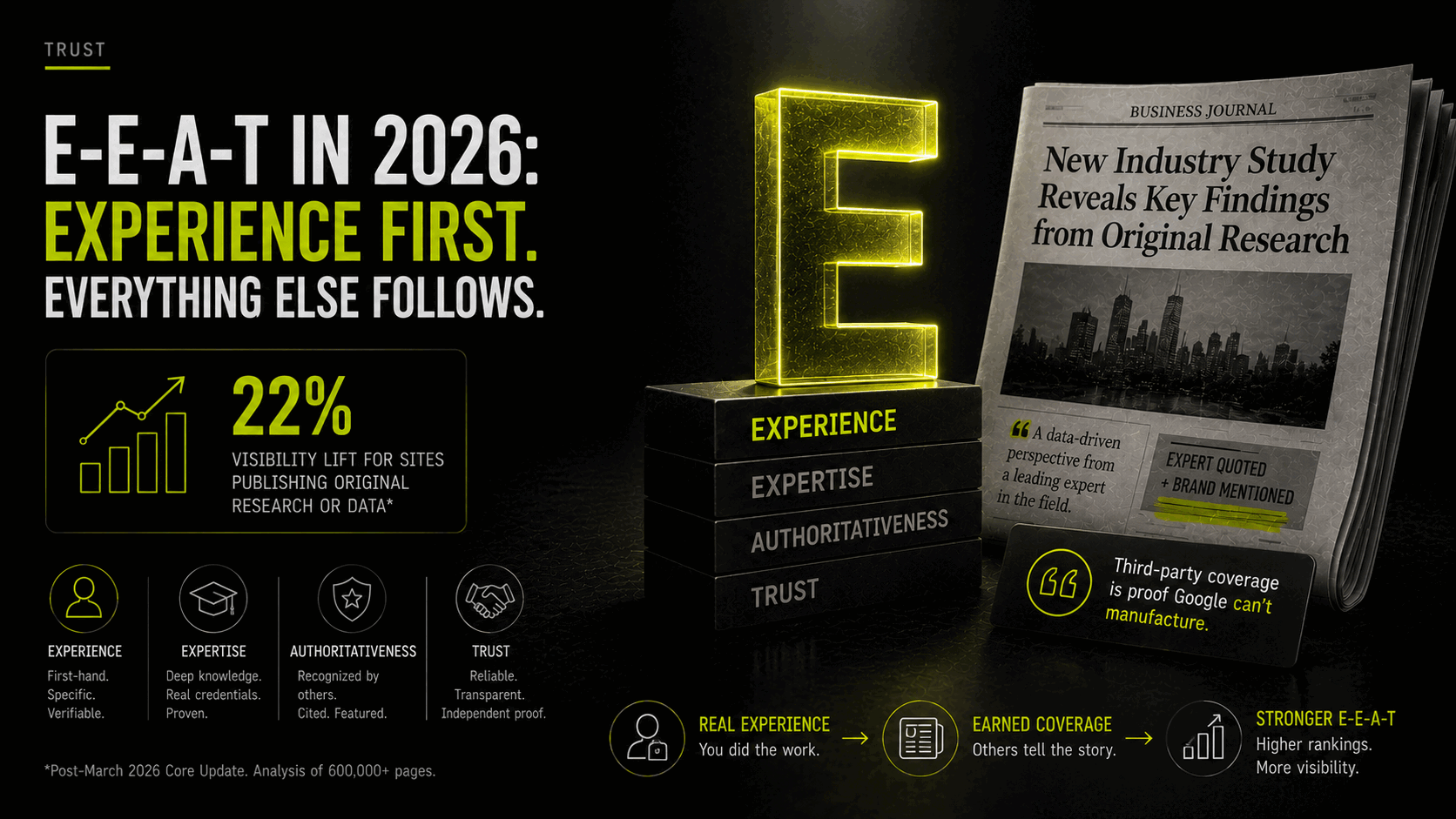
E-E-A-T has stood for the same four words since 2022 — Experience, Expertise, Authoritativeness, Trust — but Google's March 2026 core update is the point where the first "E" stopped being just one factor among four and became the one that decides most of the outcome.
What actually changed in the March 2026 update?
The update amplified genuine first-hand experience beyond every other E-E-A-T signal, so that content demonstrating specific, verifiable, original outcomes now outranks comprehensive but impersonal pages that simply cover a topic well.
That's a meaningful shift in what "good content" even means. A page can be accurate, well-structured, and thorough, and still lose to a shorter page written by someone who actually did the thing being described — because the update is explicitly rewarding evidence of having been there, not just explaining it correctly.
The measured impact: across an analysis covering more than 600,000 pages, sites publishing their own original research or data saw an average visibility increase of roughly 22% following the update. Niche publications and businesses running their own studies concentrated almost all of the measurable gain.
Does this mean Google penalizes AI-written content now?
Not categorically — the update doesn't penalize content for being AI-assisted, but pages built entirely on automated output with no human review or added depth are losing ground specifically because they lack the specificity the update rewards.
That distinction matters, because it puts the responsibility somewhere more useful than "did a human type this." A thoroughly-researched, fact-checked, specifically-detailed piece assisted by AI tools can still clear the bar. A generic, unreviewed synthesis of what's already been written elsewhere — regardless of who or what produced it — is exactly what the update is built to catch.
Why do author credentials matter more than they used to?
Sites that added structured author pages with verifiable credentials, named industry affiliations, and consistent bylines across their content saw measurable ranking improvements within weeks of the update, while anonymous or generic-author content lost ground regardless of quality.
The update also appears to extend this logic well beyond the health and finance topics E-E-A-T has traditionally focused hardest on — meaning a named, credentialed, consistently-bylined author now matters across far more categories than it used to.
How does earned press coverage actually build E-E-A-T faster than on-page changes?
A journalist independently choosing to quote, cite, or feature someone is exactly the kind of third-party validation the "Authoritativeness" and "Trust" letters were always meant to measure — and it's evidence no amount of author-bio editing on a company's own site can manufacture.
That's also why an unlinked brand mention still carries real weight under this framework even without a backlink attached — the signal E-E-A-T is measuring was never really the link itself. It was whether someone independent of the brand thought it was worth mentioning at all. A single strong placement, like the kind covered in DataPR's own case study, does more for that signal than months of on-page author-bio polish, because it's proof supplied by someone with no reason to help other than the story being real.
"Google didn't start asking whether a page was well-written. It started asking whether whoever wrote it had actually been there."
Chasing this update by rewriting author bios and adding credential badges treats the symptom. The update is measuring something further upstream — whether a real person or business did the specific thing being written about, and whether anyone independent noticed. Earned coverage is the only tactic that produces both at once.