What Google's 2026 spam updates actually changed for link builders.
Google shipped two spam updates in 2026 — March and June — and both named link manipulation directly. That's unusual. Here's what each one actually targeted, and why earned coverage was never in the blast radius.
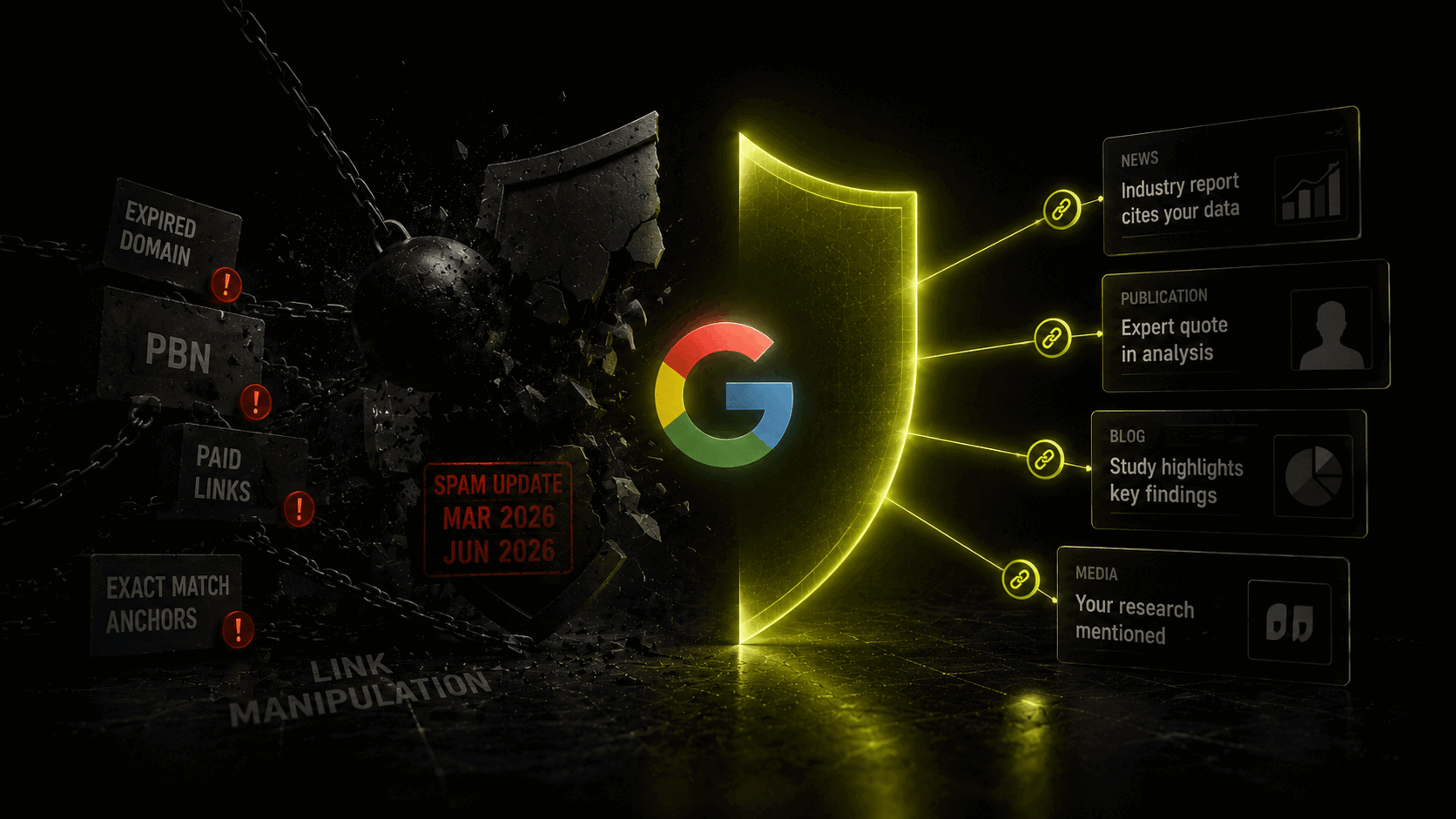
Two spam updates landed in 2026 before July even started — one in March, one in June — and both named link manipulation as a specific target. Google usually folds link signals quietly into broader core updates. Calling them out twice in five months is Google saying the same thing a second time because the first version didn't fully land.
What did the March 2026 spam update actually target?
The March update went after three specific link schemes rather than backlinks in general: expired-domain redirects, private blog networks refreshed with AI-generated content to look active, and sponsored link structures using indirect attribution to obscure a paid relationship.
Each one is a variation on the same trick — make a manipulated link look organic. Expired-domain redirects borrow an old site's authority and point it somewhere new. Refreshed PBNs use AI content generation to make a dormant blog network look freshly active again, cheaply, at scale. Indirect-attribution sponsorships route the payment through a third party so the linking page itself never has to disclose it. Google's detection systems had apparently caught up to all three by the time this update shipped.
What changed with the June 2026 update?
The June update extended Google's SpamBrain link-detection system into AI-generated search answers, so a manipulated link profile can now suppress a site from an AI Overview citation, not just push it down a ranking position.
That's the part worth sitting with. A penalty used to mean fewer clicks from page one. Now it can mean a brand simply doesn't exist inside the answer a growing share of searchers never scroll past. The mechanism is the same fraud-detection logic Google has run for years — it's the surface area that expanded.
The single biggest tell: across penalized link profiles reviewed after the 2026 updates, exact-match commercial anchor text concentration was the most common flag, present in 82% of cases — ahead of raw link volume, source quality, or velocity. Not how many links. What the link text says.
Is a ranking drop after a spam update actually a link penalty?
Not automatically — plenty of sites lost visibility around both 2026 updates for reasons that had nothing to do with their backlinks, and assumed a link problem because the timing lined up.
Before touching a disavow file, the useful first step is checking Search Console for an actual manual action message, not just a traffic graph with a dip in it. Correlation with an update date is not the same evidence as a notification that says a link scheme was found. Disavowing real, earned links because a graph moved is how sites lose backlinks that were never the problem.
What still works after both updates
Nothing about digital PR — links earned because a journalist chose, on their own judgment, to cite a real story — was touched by either update, because the enforcement target was always the scheme, not the outcome.
That's not a coincidence or a talking point; it's the literal design of the policy. A link Google flags as manipulative is one built to pass ranking credit, independent of whether the linking page's editor cared about the content. A link earned through a pitch a journalist chose to run exists because the story was worth citing on its own — the ranking value is a side effect, not the point. Google has never needed to write a new policy to catch something it was never designed to reward in the first place. The same logic is why an unlinked brand mention still carries weight even without an anchor text to analyze at all — there's no scheme to detect because there was nothing built.
How do you check if your own link profile is actually at risk?
Three things are worth an honest look, in this order: anchor text distribution, acquisition velocity, and the actual quality of the sites doing the linking.
Anchor text first — if a meaningful share of inbound links use the exact commercial keyword you're trying to rank for, rather than a brand name, a URL, or natural phrasing, that's the pattern the 2026 updates were built to catch. Velocity second — a sudden spike in new links, especially from a similar type of low-effort source, reads as manufactured even when it isn't. Source quality last — a directory or footer link from a site with no real audience was never worth much, penalty or not.
"A link earned because a journalist wanted to cite it doesn't need to survive an algorithm update — it was never trying to fool one in the first place."
None of this means link building got harder in 2026. It means the gap between links that were earned and links that were manufactured to look earned got easier for Google to see — and easier for anyone auditing a profile to see too. The updates didn't change what a good link looks like. They just got better at telling the difference.