How to measure digital PR ROI beyond Domain Rating.
Domain Rating tells you how strong a linking site is. It tells you almost nothing about whether a campaign actually worked. Here's what does — including a metric that didn't exist two years ago.
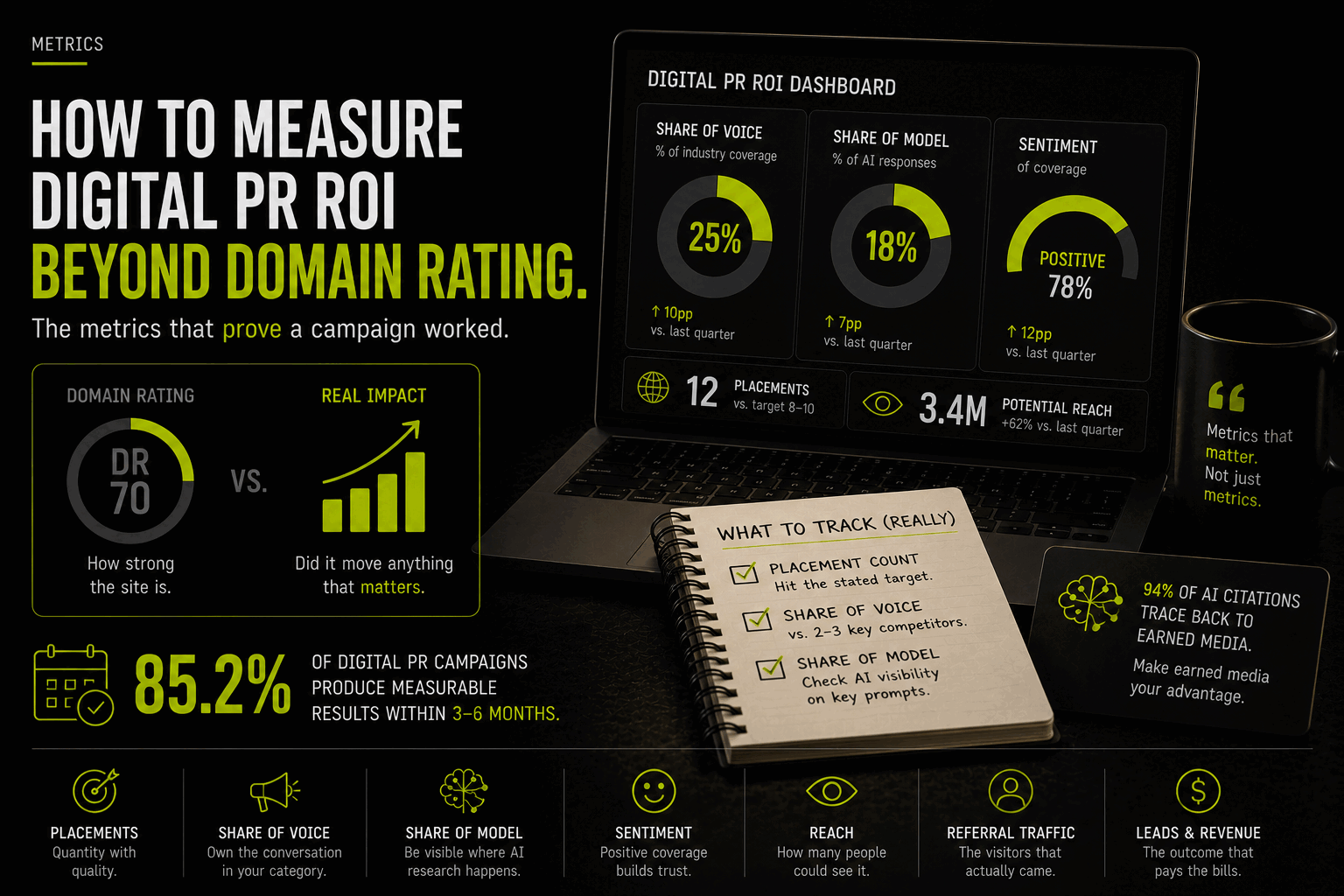
A campaign lands eight placements on strong domains. Is that a win? Domain Rating alone can't answer that question — it measures the strength of the site that linked, not whether the placement actually moved anything that matters to the business paying for it.
Why isn't Domain Rating enough as a success metric on its own?
DR measures one site's link-authority profile, which correlates loosely with ranking potential but says nothing about reach, relevance to the target audience, sentiment, or whether the coverage reached anyone who could plausibly become a customer.
A DR70 placement in a publication nobody in a business's actual market reads is a weaker outcome than a DR40 placement in a trade outlet its exact buyers follow closely — and DR alone can't distinguish between those two outcomes at all.
What is Share of Voice, and how do you actually calculate it?
Share of Voice measures a brand's presence in media coverage relative to its competitors on the same topic, using monitoring tools to track how much of an industry's overall conversation belongs to a given brand versus its rivals.
If a brand's Share of Voice grows from 15% to 25% of an industry's coverage over a quarter, that's a demonstrable gain in market mindshare — a number that means something on its own, unlike a DR figure that only means something relative to a specific ranking goal.
The AI-era version of the same metric: Share of Model measures what percentage of a language model's responses to a set of strategic prompts mention a given brand, calculated as (brand mentions ÷ total brand mentions across tracked prompts) × 100. Separately, one 2026 analysis found 94% of AI citations trace back to earned media, not paid or brand-owned content — meaning Share of Model is, in practice, largely a measure of PR performance whether or not a campaign was built with that framing in mind.
Why does Share of Model matter now specifically?
Because a growing share of buying research now happens inside an AI conversation rather than a search results page, and a brand that never shows up in a model's answer to "best options for X" is invisible to that entire research path regardless of how it ranks on Google.
Tracking this the same way unlinked brand mentions already get tracked — as a citation signal independent of backlinks — treats AI visibility as a real, measurable outcome rather than an unmeasured side effect of whatever a PR campaign happened to produce.
What's the biggest actual challenge in measuring this right now?
21% of communications professionals name measuring impact and ROI as their single top challenge, and 24% cite a lack of resources to do it properly — which is part of why volume of placements and raw reach/impressions remain the most commonly used metrics, even though sentiment and Share of Voice sit further down most teams' actual priority list despite mattering more.
That gap between what gets measured and what actually matters is mostly a resourcing problem, not a knowledge problem — most communications teams know Share of Voice matters more than a placement count. Measuring it consistently is the harder, less-resourced task.
What should a small or mid-sized business actually track, realistically?
Three things, tracked consistently rather than perfectly: placement count against a stated target (like an 8-to-10 placement guarantee), a rough Share of Voice check against two or three named competitors each quarter, and a periodic manual check of whether the brand shows up when a handful of relevant prompts are put to ChatGPT or Perplexity directly.
None of that requires enterprise monitoring software. It requires deciding, before a campaign starts, what outcome actually matters — visibility, competitive position, or AI citation — and checking that specific thing afterward, rather than defaulting to whatever number the reporting dashboard already shows.
"A high Domain Rating on the linking site was never the goal. It was always a rough proxy for a goal nobody had bothered to define more precisely."
85.2% of digital PR campaigns produce measurable results within three to six months — but "measurable" only means something once someone has decided, in advance, exactly what's being measured. Domain Rating was always a convenient placeholder for that decision, not a substitute for making it.